
Participants in the 1927 Solvay Conference on quantum mechanics in Brussels (photograph by Benjamin Couprie).
Image: Benjamin Couprie · Public domain · Wikimedia Commons
Quantum mechanics
Max Planck, Albert Einstein, Niels Bohr, Werner Heisenberg, Erwin Schrödinger, Max Born, Paul Dirac · 1900–1927
Physicists discovered that energy at the scale of atoms comes in fixed packets (quanta). Between 1925 and 1927 this led to quantum mechanics, which describes the behaviour of atoms, electrons and light.
Key facts
- Date
- 1900–1927
- Inventors and discoverers
- Max Planck
- Albert Einstein
- Niels Bohr
- Werner Heisenberg
- Erwin Schrödinger
- Max Born
- Paul Dirac
- Place
- Berlin, Germany
- Kind
- Theory
What it is
In December 1900 Max Planck explained in Berlin the radiation of a hot object by assuming that energy is only emitted in fixed amounts. In 1905 Einstein proposed that light also consists of such quanta (photons), which explained the photoelectric effect. In 1913 Niels Bohr described an atomic model in which electrons can only have certain energy levels. In 1925–1926 Werner Heisenberg (matrix mechanics) and Erwin Schrödinger (wave mechanics) developed two equivalent mathematical descriptions. Max Born proposed that the theory only predicts probabilities, and in 1927 Heisenberg formulated the uncertainty principle. The new theory was discussed at length at the 1927 Solvay Conference in Brussels.
Who came first?
Quantum theory was the work of a large group of physicists, including Louis de Broglie, Wolfgang Pauli and Pascual Jordan. Its founders disagreed about the interpretation, for example the role of probability and measurement; Einstein and Bohr debated it for years.
Impact
Quantum mechanics explains chemical bonding, the periodic table, the properties of metals and semiconductors and how stars work. It underlies the transistor, the laser, MRI scanners, atomic clocks and solar cells. Quantum computers and quantum communication are applications still under development.
The chain on the map
Elsewhere on the site
Builds on
Earlier breakthroughs this one builds on.
 Unknown author · Public domain · Wikimedia CommonsIn 1820 Hans Christian Ørsted saw that an electric current deflects a compass needle: electricity and magnetism turned out to be linked.Astronomy and physicsDiscoveryUnknown author · Public domain · Wikimedia Commons
Electromagnetism
1820 · CopenhagenHans Christian Ørsted, André-Marie Ampère Henri Becquerel · Public domain · Wikimedia CommonsIn Paris in 1896 Henri Becquerel discovered that uranium salts give off radiation by themselves. Marie and Pierre Curie then found new radioactive elements and named the phenomenon radioactivity.Astronomy and physicsDiscoveryHenri Becquerel · Public domain · Wikimedia Commons
Radioactivity
1896–1898 · Paris, FranceHenri Becquerel, Marie Curie, Pierre Curie, Ernest Rutherford
Led to
Later breakthroughs in this section that build on this one.
 Nobel Foundation · Public domain · Wikimedia CommonsIn 1928 in Calcutta C. V. Raman and K. S. Krishnan discovered that a small part of the light scattered by a substance changes its wavelength. From that change one can tell which molecules the substance contains.Astronomy and physicsDiscoveryNobel Foundation · Public domain · Wikimedia Commons
Raman effect
1928 · Calcutta (Kolkata), Indian Association for the Cultivation of Science, IndiaC. V. Raman, K. S. Krishnan Luidger; derivative work: Hic et nunc · CC BY-SA 3.0 · Wikimedia CommonsIn December 1938 Otto Hahn and Fritz Strassmann discovered in Berlin that uranium nuclei struck by neutrons split in two. Lise Meitner and Otto Frisch explained the process and calculated how much energy it releases.Energy and powerDiscoveryLuidger; derivative work: Hic et nunc · CC BY-SA 3.0 · Wikimedia Commons
Nuclear fission
1938–1939 · Berlin-Dahlem (Kaiser Wilhelm Institute for Chemistry), GermanyOtto Hahn, Fritz Strassmann, Lise Meitner, Otto Robert Frisch, Enrico Fermi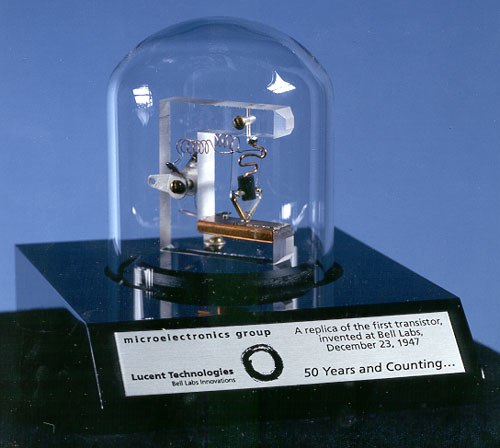 U.S. federal government · Public domain · Wikimedia CommonsIn December 1947 John Bardeen and Walter Brattain built the first working transistor at Bell Labs, an amplifier and switch made of semiconductor material. Transistors replaced the vacuum tube in almost all electronics.Mathematics and computingInventionU.S. federal government · Public domain · Wikimedia Commons
Transistor
1947 · Murray Hill (New Jersey), Bell Labs, United StatesJohn Bardeen, Walter Brattain, William Shockley National Physical Laboratory · Public domain · Wikimedia CommonsIn 1955 Louis Essen and Jack Parry built the first practical atomic clock at the British National Physical Laboratory, measuring time by the vibration frequency of caesium atoms. Since 1967 the second has been based on that frequency.Time and measurementInventionNational Physical Laboratory · Public domain · Wikimedia Commons
Atomic clock
1955 · Teddington (National Physical Laboratory), United KingdomLouis Essen, Jack Parry US Gov · Public domain · Wikimedia CommonsOn 16 May 1960 Theodore Maiman operated the first laser at Hughes Research Laboratories in California: a ruby rod lit by a flash lamp that emitted a narrow beam of red light of a single wavelength.Astronomy and physicsInventionUS Gov · Public domain · Wikimedia Commons
Laser
1960 · Malibu (Hughes Research Laboratories), United StatesTheodore Maiman, Charles Townes, Arthur Schawlow, Gordon Gould CERN for the ATLAS and CMS Collaborations · CC BY-SA 3.0 · Wikimedia CommonsOn 4 July 2012 CERN researchers announced that they had found a new particle with the Large Hadron Collider: the Higgs boson, predicted in 1964 to explain the mass of elementary particles.Astronomy and physicsDiscoveryCERN for the ATLAS and CMS Collaborations · CC BY-SA 3.0 · Wikimedia Commons
Discovery of the Higgs boson
2012 · CERN, Meyrin near Geneva, SwitzerlandATLAS and CMS collaborations (CERN), Peter Higgs, François Englert, Robert Brout