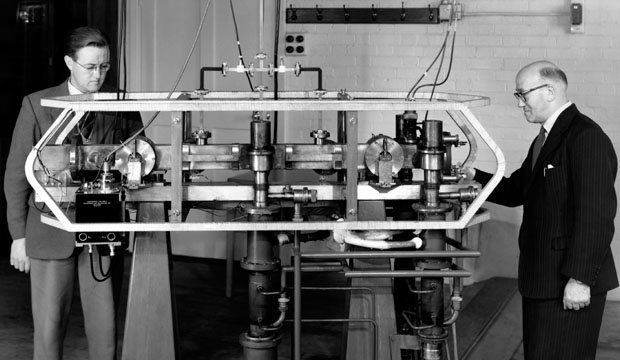
Louis Essen (right) and Jack Parry next to the first caesium atomic clock at the National Physical Laboratory, 1955.
Image: National Physical Laboratory · Public domain · Wikimedia Commons
Atomic clock
Louis Essen, Jack Parry · 1955
In 1955 Louis Essen and Jack Parry built the first practical atomic clock at the British National Physical Laboratory, measuring time by the vibration frequency of caesium atoms. Since 1967 the second has been based on that frequency.
Key facts
- Date
- 1955
- Inventors and discoverers
- Louis Essen
- Jack Parry
- Place
- Teddington (National Physical Laboratory), United Kingdom
- Theme
- Time and measurement
- Kind
- Invention
What it is
An atomic clock uses the fact that atoms only change their energy state at very specific frequencies of electromagnetic radiation. In a caesium clock a beam of caesium atoms passes through a cavity with microwaves; an electronic circuit continuously tunes the frequency so that as many atoms as possible change state. That frequency is fixed by nature and is the same everywhere. Essen had previously worked on quartz clocks and on measuring the speed of light. With Parry he built a caesium clock at Teddington that was far more stable than the best quartz and pendulum clocks. He then compared it with time as astronomers derived it from the motion of the Earth.
Who came first?
Isidor Rabi proposed using the vibrations of atoms to measure time in 1945. In the US a first prototype using ammonia molecules worked in 1949, and the US National Bureau of Standards showed that caesium could serve as a time reference. Essen and Parry built the first practical atomic clock using caesium atoms.
Impact
In 1967 the second was defined internationally as 9,192,631,770 oscillations of the caesium-133 atom. A worldwide network of atomic clocks determines International Atomic Time and Coordinated Universal Time (UTC). Atomic clocks are essential for satellite navigation, telecommunications and scientific research; newer optical clocks are much more accurate still.
The chain on the map
Builds on
Earlier breakthroughs this one builds on.
 Hansmuller · CC BY-SA 4.0 · Wikimedia CommonsIn 1656 Christiaan Huygens let a pendulum set the pace of a clock; the Hague clockmaker Salomon Coster built the first examples from 1657.Time and measurementInventionHansmuller · CC BY-SA 4.0 · Wikimedia Commons
Pendulum clock
1656 · The Hague (Dutch Republic)Christiaan Huygens, Salomon Coster Benjamin Couprie · Public domain · Wikimedia CommonsPhysicists discovered that energy at the scale of atoms comes in fixed packets (quanta). Between 1925 and 1927 this led to quantum mechanics, which describes the behaviour of atoms, electrons and light.Astronomy and physicsTheoryBenjamin Couprie · Public domain · Wikimedia Commons
Quantum mechanics
1900–1927 · Berlin, GermanyMax Planck, Albert Einstein, Niels Bohr, Werner Heisenberg, Erwin Schrödinger, Max Born, Paul Dirac
Led to
Later breakthroughs in this section that build on this one.
