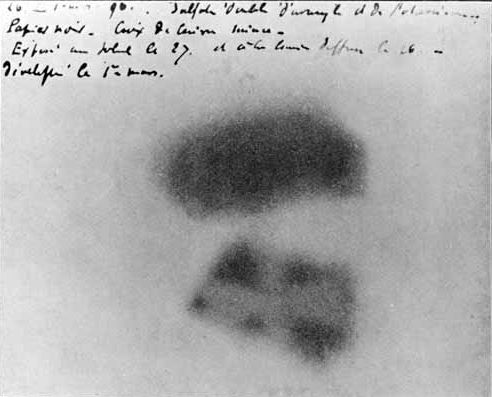
Henri Becquerel's photographic plate, darkened by radiation from a uranium salt; the shadow of a metal cross is visible (1896).
Image: Henri Becquerel · Public domain · Wikimedia Commons
Radioactivity
Henri Becquerel, Marie Curie, Pierre Curie, Ernest Rutherford · 1896–1898
In Paris in 1896 Henri Becquerel discovered that uranium salts give off radiation by themselves. Marie and Pierre Curie then found new radioactive elements and named the phenomenon radioactivity.
Key facts
- Date
- 1896–1898
- Inventors and discoverers
- Henri Becquerel
- Marie Curie
- Pierre Curie
- Ernest Rutherford
- Place
- Paris, France
- Kind
- Discovery
What it is
Becquerel wanted to know whether phosphorescent substances give off X-rays after being exposed to sunlight. He placed uranium salts on photographic plates wrapped in black paper. The plates darkened even without sunlight: the uranium emitted radiation by itself. Marie Curie studied the radiation with a sensitive electrometer developed by Pierre Curie and his brother Jacques. She found that thorium also emits radiation and that the ore pitchblende is more active than its uranium content can explain. In 1898 the Curies found two new elements in it: polonium and radium. In 1903 Becquerel and both Curies shared the Nobel Prize in Physics.
Who came first?
Henri Becquerel discovered the radiation of uranium in 1896. Marie and Pierre Curie showed that it is a property of atoms, found the elements polonium and radium and introduced the word radioactivity. From 1899 Ernest Rutherford distinguished alpha and beta radiation and established with Frederick Soddy that atoms change into other elements during radioactive decay.
Impact
Radioactivity showed that atoms are not unchangeable and led to the discovery of the atomic nucleus (1911). Radioactive substances are used in medicine, in dating rocks and archaeological finds and in nuclear energy. The health risks only became clear gradually; Marie Curie died in 1934 of an illness probably caused by radiation.
The chain on the map
Elsewhere on the site
Builds on
Earlier breakthroughs this one builds on.
 Wilhelm Röntgen · Public domain · Wikimedia CommonsOn 8 November 1895 Wilhelm Röntgen discovered in Würzburg an unknown radiation that passes through paper, wood and human tissue. Within a few weeks he made an image of the bones in a hand.Astronomy and physicsDiscoveryWilhelm Röntgen · Public domain · Wikimedia Commons
X-rays
1895 · Würzburg, GermanyWilhelm Conrad Röntgen Nicéphore Niépce · Public domain · Wikimedia CommonsAround 1827 Nicéphore Niépce was the first to fix a camera image permanently; in 1839 Louis Daguerre made the technique practical and public.Writing and communicationInventionNicéphore Niépce · Public domain · Wikimedia Commons
Photography
1826–1827 · Saint-Loup-de-Varennes (Burgundy)Nicéphore Niépce, Louis Daguerre, William Henry Fox Talbot
Led to
Later breakthroughs in this section that build on this one.
 Benjamin Couprie · Public domain · Wikimedia CommonsPhysicists discovered that energy at the scale of atoms comes in fixed packets (quanta). Between 1925 and 1927 this led to quantum mechanics, which describes the behaviour of atoms, electrons and light.Astronomy and physicsTheoryBenjamin Couprie · Public domain · Wikimedia Commons
Quantum mechanics
1900–1927 · Berlin, GermanyMax Planck, Albert Einstein, Niels Bohr, Werner Heisenberg, Erwin Schrödinger, Max Born, Paul Dirac M.Bitton · CC BY-SA 3.0 · Wikimedia CommonsIn 1912 Alfred Wegener proposed that the continents once formed one landmass and have drifted apart. In the 1960s this became part of plate tectonics: the Earth's outer shell consists of plates that move a few centimetres a year.Astronomy and physicsTheoryM.Bitton · CC BY-SA 3.0 · Wikimedia Commons
Continental drift and plate tectonics
1912–1968 · Frankfurt am Main (Senckenberg Museum), GermanyAlfred Wegener, Arthur Holmes, Marie Tharp, Harry Hess, Fred Vine and Drummond Matthews Luidger; derivative work: Hic et nunc · CC BY-SA 3.0 · Wikimedia CommonsIn December 1938 Otto Hahn and Fritz Strassmann discovered in Berlin that uranium nuclei struck by neutrons split in two. Lise Meitner and Otto Frisch explained the process and calculated how much energy it releases.Energy and powerDiscoveryLuidger; derivative work: Hic et nunc · CC BY-SA 3.0 · Wikimedia Commons
Nuclear fission
1938–1939 · Berlin-Dahlem (Kaiser Wilhelm Institute for Chemistry), GermanyOtto Hahn, Fritz Strassmann, Lise Meitner, Otto Robert Frisch, Enrico Fermi Willy Pragher · CC BY 3.0 de · Wikimedia CommonsIn the late 1940s in Chicago Willard Libby developed a method for determining the age of organic material, such as wood, bone and textiles, from the amount of radioactive carbon it still contains.Time and measurementTechniqueWilly Pragher · CC BY 3.0 de · Wikimedia Commons
Radiocarbon dating
1946–1949 · Chicago (University of Chicago), United StatesWillard Libby, James Arnold, Ernest Anderson