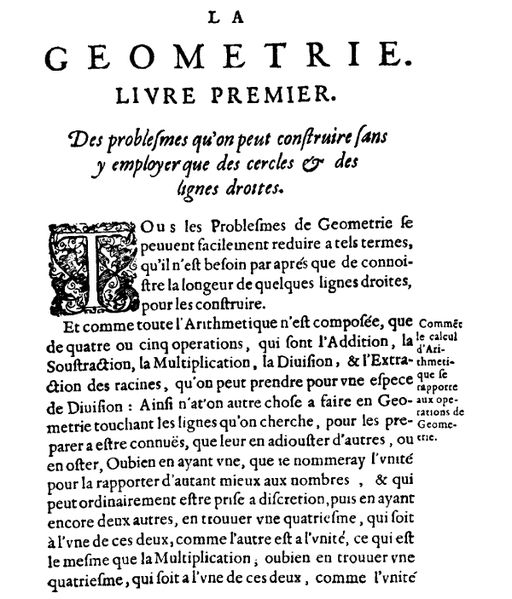
A page from René Descartes's La Géométrie (1637).
Image: René Descartes (scan: Caton, French Wikipedia) · Public domain · Wikimedia Commons
Analytic geometry
René Descartes, Pierre de Fermat · 1637
In 1637 René Descartes joined algebra and geometry: lines and curves could now be described and worked out as equations.
Key facts
- Date
- 1637
- Inventors and discoverers
- René Descartes
- Pierre de Fermat
- Place
- Leiden (Dutch Republic)
- Kind
- Technique
What it is
In La Géométrie, an appendix to his Discours de la méthode, Descartes showed how a geometric problem can be translated into an algebraic equation. A point is fixed by its distances from one or two reference lines; a curve is then the set of points satisfying an equation. He also introduced the convention of writing known quantities as a, b, c and unknowns as x, y, z, and wrote powers as x². The book was printed in Leiden in 1637 by Jan Maire; Descartes had by then lived in the Dutch Republic for years. The rectangular coordinate system now called 'Cartesian' only took its fixed form with later mathematicians. The Leiden professor Frans van Schooten made the work more widely accessible with a Latin translation and commentary (1649).
Who came first?
Pierre de Fermat developed the same method independently; his text circulated in manuscript from about 1636 but was not printed until 1679.
Impact
The method made it possible to study curves with rules of calculation instead of only with compass and straightedge. Newton and Leibniz built on it in developing the calculus. Coordinates now underlie maps, physics, engineering and computer graphics, among other things.
The chain on the map
Elsewhere on the site
Builds on
Earlier breakthroughs this one builds on.
 Muḥammad ibn Musa al-Khwarizmi · Public domain · Wikimedia CommonsIn Baghdad al-Khwarizmi wrote a textbook on solving linear and quadratic equations; the word algebra comes from al-jabr in its title.Mathematics and computingTheoryMuḥammad ibn Musa al-Khwarizmi · Public domain · Wikimedia Commons
Algebra
c. 820 · Baghdad (House of Wisdom), IraqMuhammad ibn Musa al-Khwarizmi University of Pennsylvania Museum of Archaeology and Anthropology · CC BY-SA 4.0 · Wikimedia CommonsIn thirteen books Euclid brought the geometry and number theory of his time together in one structure of proofs: theorems follow step by step from definitions and postulates.Mathematics and computingTheoryUniversity of Pennsylvania Museum of Archaeology and Anthropology · CC BY-SA 4.0 · Wikimedia Commons
Euclid's Elements
c. 300 BCE · Alexandria, EgyptEuclides
Led to
Later breakthroughs in this section that build on this one.
