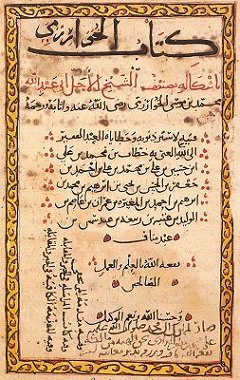
Page from a manuscript of al-Khwarizmi's Concise Book of Calculation by Restoration and Balancing
Image: Muḥammad ibn Musa al-Khwarizmi · Public domain · Wikimedia Commons
Algebra
Muhammad ibn Musa al-Khwarizmi · c. 820
In Baghdad al-Khwarizmi wrote a textbook on solving linear and quadratic equations; the word algebra comes from al-jabr in its title.
Key facts
- Date
- c. 820
- Inventors and discoverers
- Place
- Baghdad (House of Wisdom), Iraq
- Kind
- Theory
What it is
In the House of Wisdom in Baghdad, where Greek, Persian and Indian works were translated and studied under the Abbasid caliphs, Muhammad ibn Musa al-Khwarizmi wrote his Concise Book of Calculation by Restoration and Balancing around 820. He treats six standard forms of equations up to the second degree and solves them with two operations: al-jabr, moving a subtracted term to the other side, and al-muqabala, cancelling equal terms on both sides. His proofs are geometric, using squares and rectangles, and everything is written in words, without symbols. The book also contains applications to inheritance, trade and surveying. In another work al-Khwarizmi described calculation with Indian numerals.
Who came first?
Babylonian scribes, Diophantus (3rd century) and Brahmagupta already solved equations; al-Khwarizmi's book gave algebra its own name and a systematic form. Contemporaries such as Abd al-Hamid ibn Turk wrote similar works.
Impact
Robert of Chester translated the book into Latin in 1145; it was used at European universities until the 16th century. Algebra became a branch of mathematics in its own right, and the Latin form of al-Khwarizmi's name gave rise to the word algorithm.
The chain on the map
Elsewhere on the site
Builds on
Earlier breakthroughs this one builds on.
 Varun Shiv Kapur from New Delhi, India · CC BY 2.0 · Wikimedia CommonsIndian mathematicians wrote numbers with ten digits in a place-value system and treated zero as a number to calculate with; Brahmagupta gave the rules for this in 628.Mathematics and computingTheoryVarun Shiv Kapur from New Delhi, India · CC BY 2.0 · Wikimedia Commons
Zero and the decimal place-value system
628 · Bhinmal, Rajasthan, India (where Brahmagupta worked)Brahmagupta, Aryabhata, Unknown Indian calculators and astronomers University of Pennsylvania Museum of Archaeology and Anthropology · CC BY-SA 4.0 · Wikimedia CommonsIn thirteen books Euclid brought the geometry and number theory of his time together in one structure of proofs: theorems follow step by step from definitions and postulates.Mathematics and computingTheoryUniversity of Pennsylvania Museum of Archaeology and Anthropology · CC BY-SA 4.0 · Wikimedia Commons
Euclid's Elements
c. 300 BCE · Alexandria, EgyptEuclides
Led to
Later breakthroughs in this section that build on this one.
 John Napier · Public domain · Wikimedia CommonsIn 1614 John Napier published tables that reduced multiplication and division to addition and subtraction.Mathematics and computingInventionJohn Napier · Public domain · Wikimedia Commons
Logarithms
1614 · Merchiston near Edinburgh (Scotland)John Napier, Henry Briggs René Descartes (scan: Caton, French Wikipedia) · Public domain · Wikimedia CommonsIn 1637 René Descartes joined algebra and geometry: lines and curves could now be described and worked out as equations.Mathematics and computingTechniqueRené Descartes (scan: Caton, French Wikipedia) · Public domain · Wikimedia Commons
Analytic geometry
1637 · Leiden (Dutch Republic)René Descartes, Pierre de Fermat G. W. Leibniz · Public domain · Wikimedia CommonsNewton and Leibniz independently developed a mathematics of change: derivatives for the rate at which something changes, integrals for adding up infinitely small parts.Mathematics and computingTheoryG. W. Leibniz · Public domain · Wikimedia Commons
Calculus
1665–1666 · Cambridge and Woolsthorpe (Newton); Leibniz worked in ParisIsaac Newton, Gottfried Wilhelm Leibniz