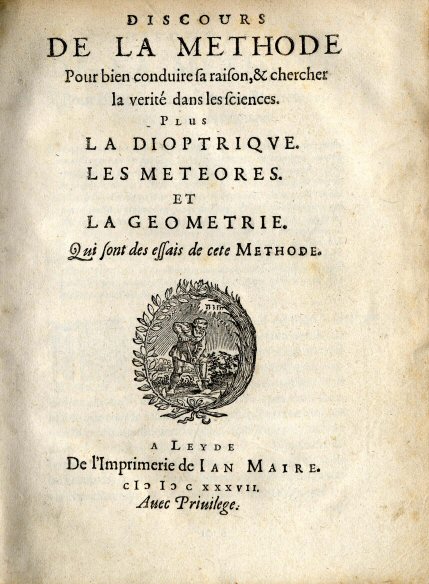
Image: Ian Maire · Public domain · Wikimedia Commons
Philosophy & ideas
Descartes publishes the Discourse on Method
8 June 1637 · Leiden
On 8 June 1637 the Leiden printer Jan Maire published, without the author's name, the Discourse on Method. René Descartes, who lived in the Dutch Republic for more than twenty years, wrote it in French and not in Latin, so that the unlearned could read it too.
He describes how he doubted everything until he struck one certainty: 'I think, therefore I am'. With the book came three essays applying the method, among them the geometry in which he describes points by numbers: the foundation of the coordinate system.
Key facts
- Date
- 8 June 1637
- Place
- Leiden
- Country
- The Netherlands
- Category
- Philosophy & ideas
- Significance
- Lesser-known
Background and run-up
Descartes was born in 1596 at La Haye in Touraine and was educated at the Jesuit college of La Flèche. In 1618 he entered the service of the army of Prince Maurice at Breda, and there he met the Middelburg scholar Isaac Beeckman. According to his own account in the 'Discourse' he arrived at the thought of a new method at the beginning of the winter of 1619, in a heated room in Germany. Around 1628 he settled in the Dutch Republic, where he often changed his place of residence.
In the Republic Descartes worked on 'Le Monde', a treatise on nature in which the earth revolved around the sun. When he heard in 1633 that the Inquisition in Rome had condemned Galileo Galilei, he decided not to publish the work. Instead he brought out 'La Dioptrique' on light and lenses and 'Les Météores' on the weather in 1637, with the 'Discourse' as an introduction. That short text told the story of his own path of thought in six parts.
Immediate consequences
The 'Discourse' gave four rules for thinking: accept nothing as true that has not been clearly grasped, divide each problem into parts, proceed from the simple to the complex and leave nothing out. Besides this Descartes drew up a provisional morality to live by for as long as his doubt lasted. In 'La Dioptrique' he published the law of the refraction of light, which Willebrord Snellius had found earlier without publishing it. 'Les Météores' explained the rainbow by the refraction and reflection of light in drops of water.
Descartes worked out the doubt and the certainty of one's own thinking further in the 'Meditationes de prima philosophia', which appeared in Paris in 1641. In Utrecht a fierce dispute arose when the professor of medicine Henricus Regius taught his ideas and the theologian Gisbertus Voetius turned against them. The senate of the university condemned the new philosophy in 1642. In 1649 Descartes left for Stockholm at the invitation of Queen Christina, and he died there in February 1650.
Legacy and remembrance
The Latin form 'ego cogito, ergo sum' appears in his 'Principia philosophiae' of 1644. Frans van Schooten translated 'La Géométrie' into Latin in 1649, and through that edition the method found its way to mathematicians. The name 'Cartesian' remained attached to the coordinate system, although Descartes did not yet work with two perpendicular axes as is done today. Pierre de Fermat worked out a similar method independently in the same years. In 1663 Rome placed the works of Descartes on the Index of Forbidden Books. In his lectures on the history of philosophy Hegel called him the true founder of modern philosophy.
Timeline
1619
Descartes is in Germany, where according to his own account he conceives the basis of his method.
22 June 1633
The Inquisition in Rome condemns Galileo Galilei, after which Descartes withholds 'Le Monde'.
8 June 1637
Jan Maire in Leiden brings out the 'Discourse on Method' with three essays.
1641
The 'Meditationes de prima philosophia' of Descartes appear in Paris.
11 February 1650
Descartes dies in Stockholm, where he had lived at the court of Queen Christina since 1649.
1663
Rome places the works of Descartes on the Index of Forbidden Books.
On the map
People involved

Sources
- Wikipedia – Discourse on the Method
- Stanford Encyclopedia of Philosophy: René Descartes
- Descartes: An Intellectual Biography (1995) · Stephen Gaukroger