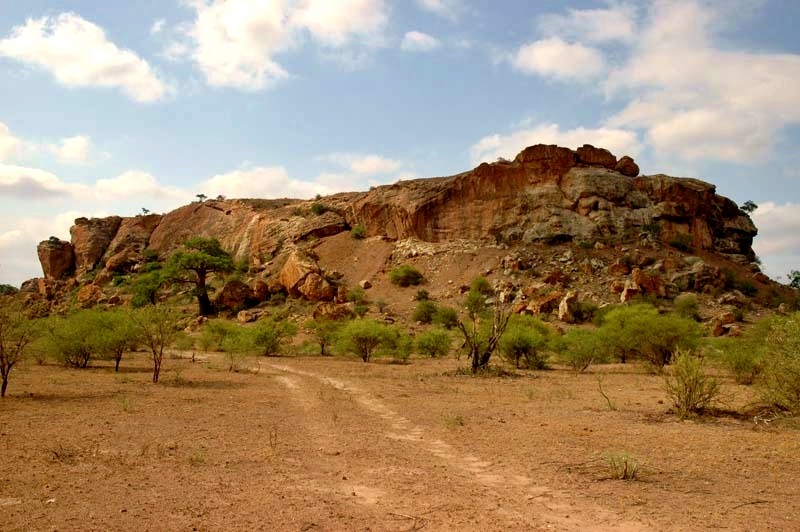
Mapungubwe
Mapungubwe documents the development of social hierarchy and state formation in southern Africa. The site corrects colonial views that denied the scale and international connections of pre-colonial African societies.
Photo: JJ van Zyl · CC BY-SA 3.0 · Wikimedia Commons
Facts
- Place
- Near the Limpopo River, South Africa
- Civilisation / patron
- Kingdom of Mapungubwe
- Built
- c. 1220 – 1290
- Status
- Ruins
- UNESCO World Heritage since
- 2003
- UNESCO World Heritage
History
A royal centre emerged on and around Mapungubwe Hill in the thirteenth century, within a landscape settled earlier. The elite lived on the hill, while other residents lived in surrounding settlements. Burial finds, including a small golden rhinoceros, attest to specialised craftwork and trade with the Indian Ocean. Around 1300 the regional centre of power shifted and the site was largely abandoned; archaeological remains now lie within a protected cultural landscape.
More from: Middle Ages & early modern
- Hagia Sophia
- Leaning Tower of Pisa
- Porcelain Tower of Nanjing
- Chichén Itzá
- Angkor Wat
- Borobudur
- Great Zimbabwe
- Rock-Hewn Churches of Lalibela
- Moai of Rapa Nui
- Forbidden City
- Alhambra
- Notre-Dame Cathedral, Paris
- Cologne Cathedral
- Machu Picchu
- Walls of Benin
- Seokguram Grotto and Bulguksa Temple
- Ayutthaya Historical Park
- Himeji Castle
- Saint Basil’s Cathedral
- Grand Place, Brussels
- Taj Mahal
- Windmills of Kinderdijk
Sources: Wikipedia — Mapungubwe · UNESCO — Cultuurlandschap Mapungubwe