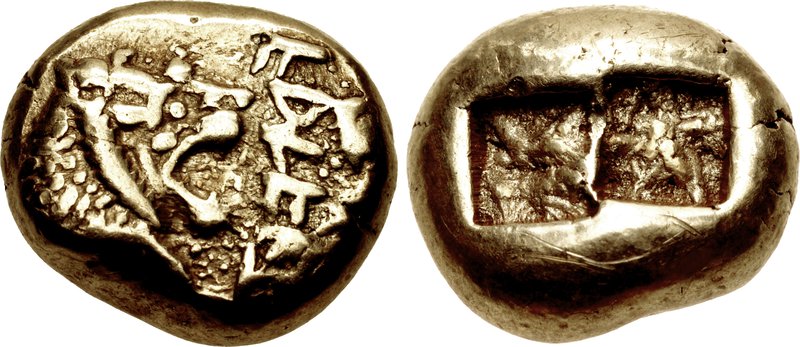
Electrum coin (trite) with a lion's head, struck at Sardis under King Alyattes of Lydia, c. 620–563 BCE
Image: Classical Numismatic Group, Inc. · CC BY-SA 3.0 · Wikimedia Commons
Coinage
Unknown minters (Lydia and Ionia) · late 7th century BCE
Small pieces of metal with a fixed weight and a stamp made payment easier; in the late 7th century BCE coins appeared in Lydia and, around the same time, in China.
Key facts
- Date
- late 7th century BCE
- Inventors and discoverers
- Unknown minters (Lydia and Ionia)
- Place
- Sardis, capital of Lydia, Turkey
- Theme
- Tools and materials
- Kind
- Invention
What it is
A coin is a piece of metal of known weight with the issuer's stamp, so that it need not be weighed at every payment. The oldest coins from western Anatolia were made of electrum, a natural alloy of gold and silver. The oldest find comes from the foundations of the Temple of Artemis at Ephesus (625–600 BCE), with coins bearing the name Phanes. Coins with a lion's head were struck for King Alyattes of Lydia (died c. 560 BCE). Because the ratio of gold to silver in electrum varied greatly, Lydia later switched to coins of pure gold and silver. In China workshops cast bronze coins shaped like spades and knives, derived from tools that had earlier served as means of exchange.
Who came first?
Coins appeared in the late 7th century BCE almost simultaneously in western Anatolia and in China, where bronze spade coins were cast at Guanzhuang (Henan) between 640 and 550 BCE. In India punch-marked silver coins appeared in the 6th century BCE. Ancient writers named various 'first' minters.
Impact
Coins spread rapidly through the Greek world and the Persian Empire and became the standard for trade, taxes and soldiers' pay. They carry images and texts of rulers and are an important source for historians in dating and political history.
The chain on the map
Builds on
Earlier breakthroughs this one builds on.
