
Bronze ding (tripod cauldron) from the Shang dynasty, Xinyang City Museum, Henan, China
Image: Gary Todd · CC0 · Wikimedia Commons
Bronze metallurgy
Unknown metalworkers (Near East) · c. 3300 BCE (start of the Bronze Age in the Near East)
Mixing copper with tin or arsenic produced bronze, harder than copper and easy to cast; it gave its name to the Bronze Age.
Key facts
- Date
- c. 3300 BCE (start of the Bronze Age in the Near East)
- Inventors and discoverers
- Unknown metalworkers (Near East)
- Place
- Mesopotamia (e.g. Ur, Iraq)
- Theme
- Tools and materials
- Kind
- Technique
What it is
Bronze is an alloy of copper with usually about 12 percent tin. It is harder than pure copper, melts at a lower temperature and casts well in moulds, including by the lost-wax technique. In the Near East arsenical bronze came first; tin bronze became common from the end of the 4th millennium BCE. Tin occurs in only a few places, so long-distance trade became necessary. Bronze was used for weapons, tools, mirrors and statues, but farmers often kept using stone tools. In China, Shang-period workshops cast large ritual vessels, and at Sanxingdui bronze masks and figures were made.
Who came first?
A tin-bronze foil from Pločnik (Serbia) of c. 4650 BCE shows that bronze occurred much earlier in the Balkans, possibly from smelting tin-bearing copper ore. Arsenical bronze came first. In China the Bronze Age began in the 2nd millennium BCE.
Impact
Bronze gave its name to a period of more than two millennia. The search for tin and copper linked distant regions through trade, and Bronze Age casting skills were later applied to bells, cannons and coins.
The chain on the map
Elsewhere on the site
Builds on
Earlier breakthroughs this one builds on.

Led to
Later breakthroughs in this section that build on this one.
 Morgan Riley · CC BY-SA 3.0 · Wikimedia CommonsSmiths learned to extract iron from ore in a bloomery furnace. Iron ore is far more common than copper and tin, so iron tools and weapons became widespread from about 1000 BCE.Tools and materialsTechniqueMorgan Riley · CC BY-SA 3.0 · Wikimedia Commons
Iron smelting
c. 1300–1000 BCE · Anatolia (one of the presumed areas of origin)Unknown smiths (Anatolia, Caucasus or Southeast Europe) Classical Numismatic Group, Inc. · CC BY-SA 3.0 · Wikimedia CommonsSmall pieces of metal with a fixed weight and a stamp made payment easier; in the late 7th century BCE coins appeared in Lydia and, around the same time, in China.Tools and materialsInventionClassical Numismatic Group, Inc. · CC BY-SA 3.0 · Wikimedia Commons
Coinage
late 7th century BCE · Sardis, capital of Lydia, TurkeyUnknown minters (Lydia and Ionia) Marsyas · CC BY 2.5 · Wikimedia CommonsA box with dozens of bronze gears, found in a shipwreck, calculated the positions of Sun and Moon, lunar phases and eclipses: the oldest known example of an analogue computer.Astronomy and physicsInventionMarsyas · CC BY 2.5 · Wikimedia Commons
The Antikythera mechanism
c. 150–100 BCE · Shipwreck off Antikythera, Greece (find site)Unknown Hellenistic scholars and instrument makers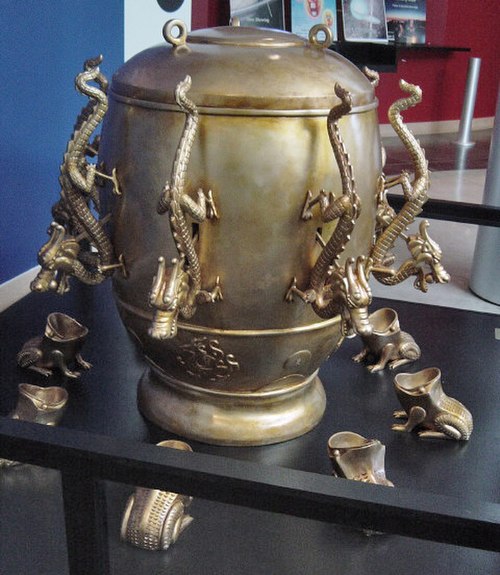 Kowloonese · CC BY-SA 3.0 · Wikimedia CommonsZhang Heng built a bronze vessel with eight dragon heads; during an earthquake a ball dropped from a dragon's mouth into the mouth of a toad below, as a signal and, according to the source, as an indication of direction.Astronomy and physicsInventionKowloonese · CC BY-SA 3.0 · Wikimedia Commons
Zhang Heng's seismoscope
132 CE · Luoyang, ChinaZhang Heng