Image: Apokryltaros · CC BY-SA 4.0 · Wikimedia Commons
Ikaria
Ikaria wariootia
560–555 Ma · Late Ediacaran
A candidate for the oldest known bilaterally symmetrical animal, the group to which most living animals belong, and a rare link between a body fossil and burrows.
Key facts
- Scientific name
- Ikaria wariootia
- Period
- Late Ediacaran
- Lived
- 560–555 Ma (560 million years ago)
- Diet
- Detritivore
- Habitat
- Open sea
- Length (estimate)
- 0.005 m
- Discovered/described
- 2020 · Scott Evans, Mary Droser et al.
Description
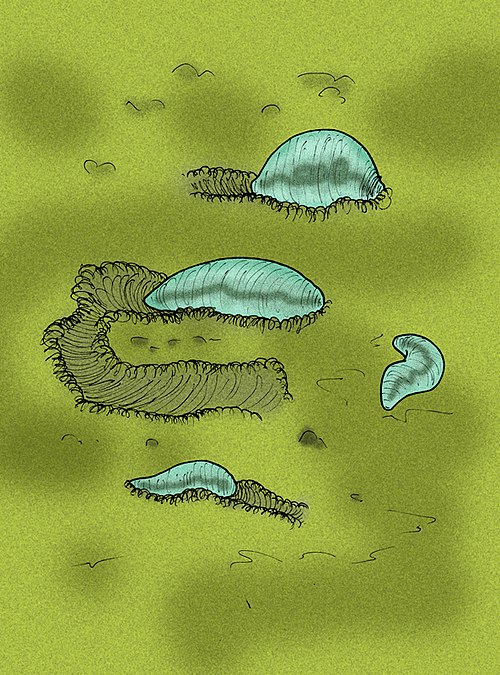
Ikaria wariootia was a worm-like organism two to seven millimetres long and one to two and a half millimetres wide, about the size of a grain of rice. It is known from small oval impressions in sandstone at Nilpena in the Flinders Ranges of South Australia, which Scott Evans, Mary Droser and colleagues examined with a 3D laser scanner and described in 2020. The impressions have a clear front and rear end, and their shape and size match Helminthoidichnites, burrows that had long been known from the same beds.
According to the authors Ikaria was an early bilaterally symmetrical animal (a bilaterian), possibly with a mouth, a gut and an anus, that moved through the sediment and took in organic matter as it went. Whether it really was a bilaterian is not certain. The name comes from the language of the Adnyamathanha, the traditional owners of the area: Ikara means 'meeting place' and is their name for Wilpena Pound; wariootia refers to Warioota Creek.
Habitat
Sandy sea floor with microbial mats in shallow water.
Fossil sites
Nilpena, Flinders Ranges
Ediacara Member (Rawnsley Quartzite)
Cultural profile: Australia →


