Image: djpmapleferryman · CC BY 2.0 · Wikimedia Commons
Fractofusus
Fractofusus misrai
571–560 Ma · Middle Ediacaran
One of the oldest large multicellular organisms; how it reproduced could be inferred from the way the fossils lie.
Key facts
- Scientific name
- Fractofusus misrai
- Period
- Middle Ediacaran
- Lived
- 571–560 Ma (571 million years ago)
- Diet
- Unknown
- Habitat
- Open sea
- Length (estimate)
- 0.3 m
- Discovered/described
- 2007 · James Gehling en Guy Narbonne
Description
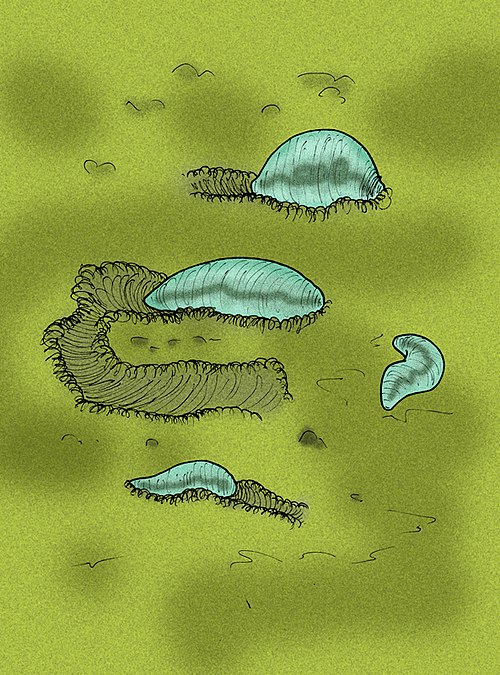
Fractofusus was a spindle-shaped, flat organism from a few centimetres to several decimetres long that lay on the deep sea floor. Its body consisted of repeating, branched units, typical of the rangeomorphs, a group without clear descendants. No mouth, gut or limbs have been found; it is often assumed that it took up nutrients directly from the water. The Indian student S.B. Misra discovered the fossils of Mistaken Point in Newfoundland in 1967; the species was named after him in 2007. A 2015 spatial analysis of how the fossils lie suggested that large specimens spread through drifting offspring, while smaller ones arose in clusters around them, possibly through runners.
Habitat
Deep sea floor below wave base, beyond the reach of sunlight.
Fossil sites
Mistaken Point, Newfoundland
Mistaken Point Formation
Cultural profile: Canada →