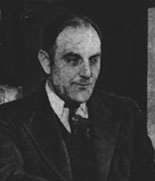
Image: Page from a 1935 Philadelphia newspaper · Public domain · Wikimedia Commons
Photographs, historical portraits or later depictions; not every person has an authentic portrait.
Victor Lustig
1890 – 1947
Swindler from Bohemia, then part of Austria-Hungary, who became known above all because in 1925 in Paris he led scrap-metal dealers to believe that the French government wanted to have the Eiffel Tower demolished; one of them paid him for the contract.
In the United States he sold fake machines that were supposed to copy money and later ran a counterfeiting operation. He was convicted in 1935 and died in custody in 1947.
Please note: this section deals with serious crimes, including murder.
Key facts
- Born
- 1890 · Hostinné (Arnau)
- Died
- 11 March 1947, 8.30 p.m.
- Place of death
- Medical Center for Federal Prisoners, Springfield, Missouri, United States
- Cause of death
- pneumonia
- Era
- Modern era, Contemporary
Background & early life
Born on 4 January 1890 in Hostinné (German: Arnau) in the Kingdom of Bohemia, the son of a tobacco merchant who was for a time also the town's mayor. He attended a boarding school in Dresden, where he learned several languages, and from 1909 studied briefly in Paris, where he took up gambling.
Societal impact
The 'sale' of the Eiffel Tower is often cited as an example of confidence fraud, but because the victim did not report it, the story rests largely on Lustig's own statements and later books.
Death & legacy
End of life
- Date
- 11 March 1947, 8.30 p.m.
- Place
- Medical Center for Federal Prisoners, Springfield, Missouri, United States
- Cause of death
- pneumonia
- Manner of death: Illness
Circumstances
From December 1935 Lustig was serving a twenty-year sentence for counterfeiting and his escape, from April 1936 on Alcatraz. There he complained constantly of illnesses; guards long suspected that he was faking and planning an escape, all the more because torn bed sheets were found in his cell. He was eventually transferred to the federal prison hospital in Springfield, Missouri, where doctors found that he was genuinely ill. On 9 March 1947 he developed pneumonia; he died two days later, at 8.30 p.m. on 11 March, aged 57. His death certificate gave his occupation as 'apprentice salesman'. According to the journalist Jeff Maysh, his family managed to keep his death secret for two years; it became known only on 31 August 1949.
His conviction concerned not that swindle but the counterfeiting, which had been tracked down by the US Secret Service.
Key moments
- According to later accounts, before the First World War worked as a swindler on passenger liners between France and New York, and afterwards moved to the United States.
- In the United States sold the so-called 'Rumanian box', a chest that was supposed to copy banknotes but only produced genuine notes hidden in it beforehand.
- In Paris in 1925, using forged letterhead, posed as a senior official of the Ministry of Posts and Telegraphs and had a scrap dealer pay for the right to demolish the Eiffel Tower; out of embarrassment the victim did not go to the police.
- Tried the same trick again later that year, but fled to the United States when the police were informed.
- From 1930 set up a counterfeiting operation with two men from Nebraska; he was arrested in New York on 10 May 1935, escaped from the federal detention centre on 1 September and was recaptured in Pittsburgh 27 days later.
- Pleaded guilty and in December 1935 was sentenced to fifteen years for counterfeiting and five years for his escape; he was held at Alcatraz among other prisons and died on 11 March 1947 in the federal prison hospital in Springfield, Missouri.
Known travels & key locations
Recorded places in this person's life. Connecting lines are schematic, not exact travel routes.