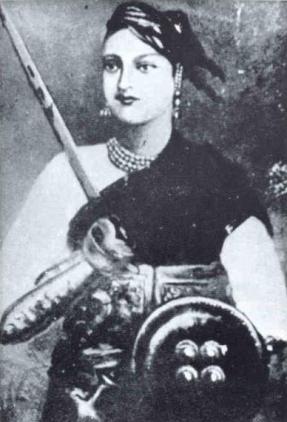
Image: Unknown · Public domain · Wikimedia Commons
Photographs, historical portraits or later depictions; not every person has an authentic portrait.
Lakshmibai, Rani of Jhansi
1828 – 1858
Queen (rani) of the Indian princely state of Jhansi and one of the leading figures of the Indian Rebellion of 1857. After the British East India Company had annexed Jhansi in 1854, she took over the government of the state during the rebellion.
She defended Jhansi against British troops in 1858, escaped and was killed in battle near Gwalior in June 1858; in India she became a symbol of national resistance.
Key facts
- Born
- 1828 · Varanasi
- Died
- 18 June 1858 (some sources: 17 June)
- Place of death
- Kotah-ki-Serai, near Gwalior (India)
- Cause of death
- killed in a fight with British cavalry; struck by a bullet, a sabre or both
- Era
- Modern era
Background & early life
Born Manikarnika Tambe in Varanasi into a Marathi Brahmin family; her year of birth is uncertain (dates from 1827 to 1835 are given). She grew up at Bithoor at the court of the deposed peshwa Baji Rao II, where according to tradition she learned to ride and handle weapons, and in 1842 married the maharaja of Jhansi, Gangadhar Rao, after which she was given the name Lakshmibai.
Societal impact
After the rebellion her story grew into a national legend, not least through the poem 'Jhansi ki Rani' by Subhadra Kumari Chauhan (1930). In the Second World War a women's regiment of Subhas Chandra Bose's Indian National Army was named after her.
Death & legacy
End of life
- Date
- 18 June 1858 (some sources: 17 June)
- Place
- Kotah-ki-Serai, near Gwalior (India)
- Cause of death
- killed in a fight with British cavalry; struck by a bullet, a sabre or both
- Manner of death: Killed in battle
Circumstances
After the fall of Jhansi and Kalpi, Lakshmibai, Tatya Tope and Rao Sahib took the fortress of Gwalior in early June 1858 with the support of the Gwalior Contingent, which had changed sides. General Hugh Rose advanced with his army and attacked on 17 June. On hilly ground between Kotah-ki-Serai and Gwalior, units of the 95th Regiment met troops under her command, and a squadron of the 8th Hussars surprised her bodyguard. According to an eyewitness she charged the horsemen, possibly together with a female companion, Mundar. The exact manner of her death is unknown; Britannica says she may have been shot, struck by a sabre or both, but all accounts agree that she died fighting. The date is given as 17 or 18 June; in India 18 June is commemorated. Her followers probably cremated her body nearby. Rose took Gwalior on 19 June.
She is commemorated in films, novels and statues, although Dalit communities also view her critically.
Key moments
- Her son died in infancy; shortly before his own death in November 1853 Gangadhar Rao adopted a young relative, Damodar Rao, as his heir.
- Governor-General Dalhousie refused to recognise the adoption and annexed Jhansi in March 1854 under the 'doctrine of lapse'; her petitions were rejected.
- Took over the government of the state in June 1857, after mutinous sepoys in Jhansi had killed most of the British residents; whether she was involved in that massacre is disputed.
- Defended Jhansi against General Hugh Rose's troops in March and April 1858 and escaped on horseback when the city was taken; with Tatya Tope and other leaders she then took Gwalior.
- Was killed in fighting at Kotah-ki-Serai, near Gwalior, on 18 June 1858.
Known travels & key locations
Recorded places in this person's life. Connecting lines are schematic, not exact travel routes.