
Image: Unknown author Unknown author Cambridge University Press; Stanford's Geogl. Estabt.. · Public domain · Wikimedia Commons
Revolution & uprising
Indian Rebellion of 1857
10 May 1857 · Meerut, Uttar Pradesh
On 10 May 1857 Indian soldiers of the British East India Company mutinied at Meerut, after comrades had been imprisoned for refusing cartridges rumoured to be greased with cow and pig fat. They marched to Delhi and proclaimed the aged Mughal emperor Bahadur Shah their leader.
The rebellion spread across northern and central India and was suppressed with great violence in 1858; massacres took place on both sides. London then dissolved the company and India came directly under the British crown.
Key facts
- Date
- 10 May 1857
- Place
- Meerut, Uttar Pradesh
- Country
- India
- Category
- Revolution & uprising
- Significance
- Major
Background and run-up
After the Battle of Plassey in 1757 the East India Company extended its rule over India step by step, partly through wars and partly through treaties with princes. Governor-General Lord Dalhousie annexed Satara, Jhansi and Nagpur, among others, between 1848 and 1856 under the 'doctrine of lapse': a princely state passed to the company if the ruler died without a son of his own. In Jhansi the company therefore refused to recognise the adopted son of the late raja, and his widow Lakshmibai protested in vain. Many soldiers of the Bengal Army came from Awadh, and in February 1856 the company annexed that kingdom on grounds of misgovernment.
Distrust grew in the army. The General Service Enlistment Act of July 1856 obliged new recruits to serve overseas as well, which in the view of many high-caste Hindus led to a loss of caste. Early in 1857 the new Enfield rifle was introduced, whose paper cartridges had to be torn open with the teeth according to the drill. On 29 March 1857 the sepoy Mangal Pandey attacked British officers at Barrackpore near Calcutta, and at the beginning of April he was hanged. At Meerut 85 troopers of the 3rd Light Cavalry refused the cartridges on 24 April, and on 9 May most of them were sentenced to ten years' imprisonment and publicly put in chains.
What happened
On the evening of 10 May the rebels freed their comrades and killed British officers and civilians. Early on 11 May the first horsemen reached Delhi. In the following weeks garrisons in Awadh and elsewhere in the Ganges plain rose, and at Kanpur Nana Sahib, the adopted son of the last peshwa of the Marathas, took the lead. The British garrison of Kanpur surrendered in June, but at the embarkation on 27 June most of the men were killed, and in July the captive women and children were murdered as well. At Lucknow rebels surrounded the residency from the end of June, where British people and loyal Indian soldiers had entrenched themselves.
A British army on the ridge north of Delhi besieged the city from June onwards. After an assault on 14 September and a week of street fighting the British retook the city, and on 20 September Bahadur Shah surrendered at Humayun's tomb. Shortly afterwards the officer William Hodson had three princes of his family shot on his own authority. Henry Havelock and James Outram reinforced the defence of Lucknow at the end of September, and in November Colin Campbell had the residency evacuated. In 1858 an army under Hugh Rose reconquered central India, and Lakshmibai was killed in June in the fighting for Gwalior.
Immediate consequences
How many people died is not known. On the British side thousands of soldiers and civilians were killed. On the Indian side the numbers were much higher because of battles, summary executions and punitive expeditions against villages, but historians give widely differing estimates. Bahadur Shah was tried in Delhi early in 1858, found guilty and exiled to Rangoon in Burma, where he died in 1862. With him the Mughal dynasty came to an end. The British declared the hostilities formally ended only on 8 July 1859.
With the Government of India Act of August 1858 the Crown took over the government. A Secretary of State for India in London and a viceroy in Calcutta took the place of the company, and Lord Canning, the governor-general during the rebellion, became the first viceroy. In a proclamation of 1 November 1858 Queen Victoria promised that the government would not interfere with the religion of her subjects and that the rights of the Indian princes would be respected. The army was reformed: the proportion of British soldiers was increased, the artillery came into British hands and recruitment shifted to the Punjab and Nepal.
Legacy and remembrance
There is no agreement on the name of the rebellion. In British accounts it was long called the 'Indian Mutiny' or 'Sepoy Mutiny'. The Indian nationalist Vinayak Damodar Savarkar called it the 'Indian War of Independence' in a book in 1909, and that view became common in India. In 2007 the Indian government commemorated the hundred and fiftieth anniversary as that of the first war of independence. Historians such as Eric Stokes pointed out that the rebellion differed in character from region to region: a mutiny of soldiers, but also resistance by peasants, landholders and princes who had lost rights or land.
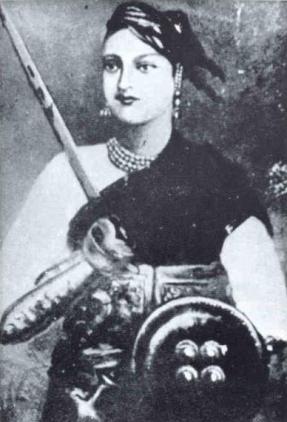
Lakshmibai, the rani of Jhansi, became a symbol of resistance to British rule in nationalist India. The Indian National Army of Subhas Chandra Bose named a women's regiment after her in 1943. In 1863 the British built a memorial to their dead on the ridge at Delhi, which India renamed Ajitgarh in 1972, with an inscription in honour of the Indian fighters. The residency in Lucknow was preserved as a ruin. William Dalrymple described the fall of Delhi in 'The Last Mughal' (2006) on the basis of Persian and Urdu documents from Indian archives.
Timeline
February 1856
The East India Company annexes the kingdom of Awadh.
29 March 1857
The sepoy Mangal Pandey attacks British officers at Barrackpore.
10 May 1857
Soldiers at Meerut rise and free their condemned comrades.
11 May 1857
The first rebels reach Delhi and seek the support of Bahadur Shah.
20 September 1857
Bahadur Shah surrenders to the British at Humayun's tomb.
June 1858
Lakshmibai is killed in the fighting for Gwalior.
August 1858
The Government of India Act places the government of India under the Crown.
1 November 1858
Queen Victoria addresses the people of India in a proclamation.
On the map
People involved
Sources
- Wikipedia – Indian Rebellion of 1857
- Encyclopaedia Britannica: Indian Mutiny
- The Last Mughal: The Fall of a Dynasty, Delhi, 1857 (2006) · William Dalrymple