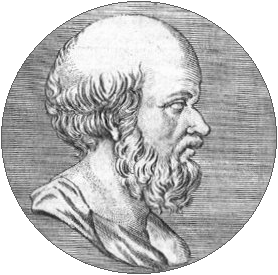
Image: Unknown · Public domain · Wikimedia Commons
Photographs, historical portraits or later depictions; not every person has an authentic portrait.
Eratosthenes
276 BCE – 195 BCE
Greek scholar from Cyrene who headed the library of Alexandria from about 245 BC and worked in mathematics, geography, astronomy, chronology and poetry. He calculated the circumference of the Earth from shadow measurements at Alexandria and Syene, drew a world map with parallels and meridians and is the earliest known author to use the word geography.
Key facts
- Born
- 276 BCE · Cyrene
- Died
- around 195/194 BC (estimates range from 196 to 194 BC)
- Place of death
- Alexandria, Ptolemaic Egypt
- Cause of death
- uncertain; according to the much later Suda, suicide after he had gone blind, while his epitaph speaks of old age
- Era
- Antiquity
Background & early life
Eratosthenes was born around 276 BCE in Cyrene, on the coast of North Africa, at a time when the city was under the rule of Magas, a stepson of the Egyptian king Ptolemy I. Apart from the name of his father, nothing has come down about his family. According to the Suda he was taught in his native city by the grammarian Lysanias. The poet Callimachus, who also came from Cyrene, is sometimes called his teacher, but historians consider it unlikely that he formally studied with him.
In Athens, where he stayed for about twenty years, Eratosthenes heard among others Aristo of Chios, a pupil of Zeno of Citium who departed from Stoic doctrine on essential points. Historians connect the fact that King Ptolemy III brought him in particular to Alexandria with his origins. Queen Berenice II, the king's wife, was a daughter of Magas of Cyrene. Eratosthenes was about thirty years old at his appointment.
Core activities & thinking
As head of the library Eratosthenes was in charge of the most famous collection of books in the Greek world, and his own work covered almost every subject represented in it. According to the Roman writer Suetonius he was the first to call himself 'philologos', a lover of learning in the broad sense. In twelve books 'On Old Comedy' he discussed the language and the texts of the Athenian comedies. He also wrote poems, such as 'Hermes' and 'Erigone', and a mathematical and philosophical work called 'Platonikos'.
For the Delian problem, the construction of a cube with twice the volume of a given cube, Eratosthenes designed an instrument with sliding plates. According to the later commentator Eutocius he presented the solution to the king with a bronze model and an epigram. Eutocius also gives a letter from Eratosthenes to the king, whose authenticity is doubted. With the sieve that bears his name, prime numbers are found by repeatedly striking out of a row of numbers the multiples of the smallest number remaining.
In the 'Geographika' Eratosthenes rejected the poems of Homer as a source for geography. According to Strabo he mocked that the wanderings of Odysseus would be found only when one found the man who had sewn up the bag of winds. For his map he used among other things the distances measured on the campaigns of Alexander the Great, and he drew a main parallel through Rhodes. In his chronology he fixed the years of Olympic victors, so that events from different Greek cities came onto a single timeline.
Zeitgeist & culture
In the third century BCE Alexandria was the capital of the Ptolemies, a Macedonian dynasty that had ruled Egypt since the death of Alexander the Great. The kings maintained scholars at the Mouseion, which gave them lodging and meals, and had books collected on a large scale. According to the much later physician Galen, books were seized from ships in the harbour to be copied. Without that collection Eratosthenes could not have compiled his survey of the known world from older travel accounts and maps.
Hellenistic science was carried by a small number of scholars who lived scattered around the Mediterranean and kept one another informed by letter. Archimedes in Syracuse sent his new results to colleagues in Alexandria, and the astronomer Aristarchus of Samos had shortly before tried to estimate the distances to the Sun and the Moon by geometry. That the Earth is a sphere had been generally accepted among Greek scholars since Aristotle. The open question was not its shape but its size, and that was what Eratosthenes set out to measure.
Societal impact
The breadth of his work earned him contrasting nicknames. According to the Suda critics called him 'Beta', because he was supposedly second in every field, while admirers called him 'Pentathlos', after the all-round athlete of the pentathlon. His map was criticised in the second century BCE by the astronomer Hipparchus, who held that the positions of places should be determined by astronomical observations.
His chronology became the basis for later Greek chronographers, such as Apollodorus of Athens, who built his chronicle in the second century BCE on that of Eratosthenes. For the size of the Earth later scholars arrived at other results. In the second century CE Ptolemy used a much smaller circumference, which became known in Western Europe from the beginning of the fifteenth century through a Latin translation of his 'Geographia'.
Death & legacy
End of life
- Date
- around 195/194 BC (estimates range from 196 to 194 BC)
- Place
- Alexandria, Ptolemaic Egypt
- Cause of death
- uncertain; according to the much later Suda, suicide after he had gone blind, while his epitaph speaks of old age
- Manner of death: Unknown
Circumstances
Eratosthenes was head of the Library of Alexandria for decades and, at the end of his life, adviser and companion to Queen Arsinoe III. According to the Suda, a tenth-century Byzantine lexicon, his eyesight failed in old age. Because he could no longer read or observe nature, he is said to have become depressed and to have taken his own life. That story was written down more than a thousand years later and cannot be verified. The epitaph that Dionysius of Cyzicus wrote for him speaks instead of a gentle old age without disease that put him to sleep, and laments that he lay buried in a foreign land, on 'the shore of Proteus' (Egypt). He was about eighty years old and died around 195/194 BC in Alexandria.
No work by Eratosthenes survives complete. His geography is known mainly from the quotations and criticism in Strabo, his measurement of the Earth from a short summary in the astronomer Cleomedes. The 'Catasterismi', a collection of myths about the constellations that bears his name, is a later adaptation that does go back to a genuine work of his. Modern editions gather the scattered fragments, such as the translation with commentary of the 'Geographika' that Duane Roller published in 2010.
In teaching his measurement now serves as a textbook example of reasoning with geometry. Historians point out that the calculation rests on simplifications: Syene does not lie exactly south of Alexandria, nor exactly on the Tropic of Cancer. It is also unclear whether the distance between the two cities was really measured or was a rounded figure. Schools in various countries repeat the experiment around an equinox by comparing shadows at different places.
Key moments
- Was summoned from Athens to Alexandria by King Ptolemy III around 245 BC to succeed Apollonius of Rhodes as head of the library, a post that included tutoring the crown prince, the future Ptolemy IV.
- Corresponded with Archimedes, who addressed his Method of Mechanical Theorems to him and sent him the Cattle Problem to put to the mathematicians of Alexandria.
- Determined the circumference of the Earth: according to Cleomedes he measured in Alexandria a shadow angle of one fiftieth of a circle at the time when the Sun stood directly overhead at Syene, and with a distance of 5,000 stadia between the two cities arrived at 250,000 stadia.
- In his Geographika, of which only fragments survive in later authors such as Strabo, described the known world with a grid of parallels and meridians and a division into five climate zones; he also determined the tilt of the Earth's axis.
- In his Chronographiai drew up a chronology that placed the fall of Troy in 1184/1183 BC and linked later history to the Olympiads.
Known travels & key locations
Recorded places in this person's life. Connecting lines are schematic, not exact travel routes.
Related events
Elsewhere on the site
Sources
- Wikipedia: Eratosthenes
- Encyclopaedia Britannica: Eratosthenes
- Eratosthenes von Kyrene: Studien zur hellenistischen Kultur- und Wissenschaftsgeschichte (2002) · Klaus Geus
- Eratosthenes' Geography (2010) · Duane W. Roller