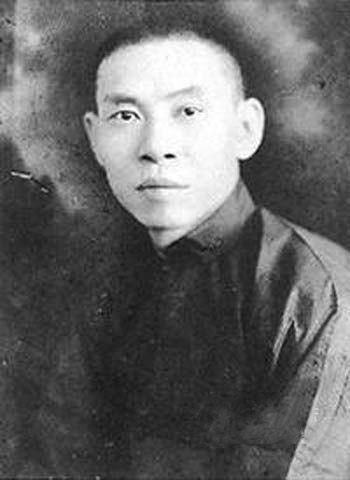
Image: Unknown author · Public domain · Wikimedia Commons
Photographs, historical portraits or later depictions; not every person has an authentic portrait.
Du Yuesheng
1888 – 1951
Chinese crime leader who in the Shanghai of the 1920s and 1930s was one of the leaders of the Green Gang, a network that, with the tacit support of the police and authorities, controlled the opium trade, gambling and prostitution in the French Concession.
In April 1927 his organisation helped Chiang Kai-shek violently break up communist groups and trade unions. He later also became a banker and company director with political influence.
Please note: this section deals with serious crimes, including murder.
Key facts
- Born
- 1888 · Gaoqiao (Pudong)
- Died
- 16 August 1951
- Place of death
- his home in Hong Kong
- Cause of death
- illness; his health declined rapidly because of chronic asthma
- Era
- Modern era, Contemporary
Background & early life
Born on 22 August 1888 in Gaoqiao in Pudong, across the river from Shanghai. By the age of nine he had lost his immediate family. From 1902 he worked at a fruit stall in the French Concession, was dismissed for theft and joined the Green Gang at sixteen; Huang Jinrong, the highest-ranking Chinese detective in the concession police, became his patron.
Societal impact
Du Yuesheng is cited as an example of the entanglement of organised crime, business and politics in Republican China.
Death & legacy
End of life
- Date
- 16 August 1951
- Place
- his home in Hong Kong
- Cause of death
- illness; his health declined rapidly because of chronic asthma
- Manner of death: Illness
Circumstances
Du Yuesheng left Shanghai in April 1949, shortly before the Communists took the city, and settled in British Hong Kong despite overtures from both the Kuomintang and the Communists. In 1950 he married the Peking opera singer Meng Xiaodong there, his fifth wife. Chronic asthma caused his health to decline rapidly, and he died at his home in Hong Kong on 16 August 1951, aged 62. His wake was held at a funeral parlour in Hong Kong. In his will he expressed the wish to be buried one day in his birthplace, Gaoqiao near Shanghai. His coffin was taken to Taiwan in October 1952 and interred at Xizhi near Taipei in June 1953; Chiang Kai-shek wrote the inscription. Some doubt whether the tomb actually contains his body.
Last words
Reliability: reported laterJesus, save me.
Original wording耶稣救我 (Yēsū jiù wǒ)
According to the dedication that Qian Xinzhi, chairman of the funeral committee, wrote in the Bible placed in the coffin, Du said these words several times when the pastor Zhao Shiguang prayed for him at his deathbed; Qian noted that neither of them was a Christian. The story is known from Zhang Junku's biography of Du.
Source: Wikipedia (ZH): 杜月笙 (met verwijzing naar de biografie door Zhang Junku) (opens in a new tab)
Opinions of him differ: in Nationalist circles he was honoured for his support and charity, and in Taiwan, where he was buried, there is a statue of him; historiography in the People's Republic describes him as a gangster and as sharing responsibility for the violence of 1927.
Key moments
- After 1924 formed, with Huang Jinrong and Zhang Xiaolin, the so-called 'Three Tycoons of Shanghai', who controlled gambling dens, protection rackets and the opium trade in the French Concession.
- In April 1927 supplied armed men for the purge of communists and trade unionists in Shanghai; estimates of the number of dead and missing vary widely.
- From 1928 founded his own bank and became a director of the Bank of China, the Bank of Communications and the Shanghai cotton and stock exchanges.
- After the Japanese occupation of Shanghai in 1937 refused to cooperate with the occupiers and left for Hong Kong and, after the Japanese took it at the end of 1941, for Chongqing; during the war his networks smuggled goods and weapons for the Nationalists.
- Left for Hong Kong in 1949, shortly before the communists took Shanghai, and died there on 16 August 1951.
Known travels & key locations
Recorded places in this person's life. Connecting lines are schematic, not exact travel routes.