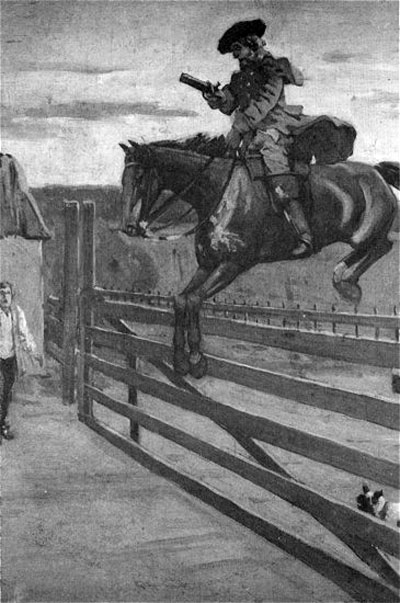
Image: George Cruikshank; the book was written by William Harrison Ainsworth · Public domain · Wikimedia Commons
Photographs, historical portraits or later depictions; not every person has an authentic portrait.
Dick Turpin
1705 – 1739
English poacher, burglar, highwayman and horse thief of the 1730s who was hanged at York in 1739 for horse theft. He first belonged to a gang that raided farmhouses in Essex and around London and then robbed travellers on the roads. His later romantic image derives mainly from ballads, plays and a novel of 1834.
Please note: this section deals with serious crimes, including murder.
Key facts
- Born
- 1705 · Hempstead (Essex)
- Died
- 7 April 1739
- Place of death
- Knavesmire, York, England
- Cause of death
- execution by hanging
- Era
- Early modern period
Background & early life
Baptised on 21 September 1705 in Hempstead, Essex, the son of a butcher who also kept an inn. According to later accounts he was apprenticed to a butcher; around 1725 he married Elizabeth Millington and opened a butcher's shop in Buckhurst Hill.
Societal impact
In the eighteenth century Turpin was known mainly from newspapers and accounts of his trial.
Death & legacy
End of life
- Date
- 7 April 1739
- Place
- Knavesmire, York, England
- Cause of death
- execution by hanging
- Manner of death: Execution
Circumstances
Turpin was convicted of horse theft at York on 22 March 1739 and sentenced to death. In York gaol he received many visitors and rejected the admonitions of a local clergyman. He bought a new coat and shoes and, the day before his execution, hired five mourners. On 7 April 1739 he and the horse thief John Stead were driven through York in an open cart to the gallows on the Knavesmire. According to the reports he bowed to the spectators and remained composed. Because York had no permanent hangman, a pardoned highwayman, Thomas Hadfield, acted as executioner. According to The Gentleman's Magazine, Turpin spoke a few words with him, threw himself off the ladder and died within five minutes. He was buried in the churchyard of St George's, Fishergate. Body snatchers stole the corpse soon afterwards, but a crowd recovered it and it was reburied; whether the grave is genuinely his is uncertain.
Later the story arose of an overnight ride from London to York on the horse Black Bess, borrowed from a ride that Daniel Defoe had attributed to the highwayman William Nevison; William Harrison Ainsworth made it widely known in his novel 'Rookwood' (1834). This image differs markedly from the documented violent robberies.
Key moments
- In the early 1730s became involved with the Essex Gang, which first poached deer in the royal forests and in 1734–1735 violently raided isolated farmhouses.
- After several gang members were arrested and executed in 1735 turned to highway robbery, first with Thomas Rowden and in 1737 with Matthew King.
- On 4 May 1737, near Epping Forest, killed a forest keeper's servant who tried to apprehend him; the government then offered 200 pounds for his capture.
- From mid-1737 lived in Brough, Yorkshire, as a horse dealer under the name John Palmer; after an incident in October 1738 in which he shot a cockerel and threatened a man, he was detained and suspected of horse theft.
- Was unmasked in February 1739 when a former schoolmate from Essex, who had taught him to write, recognised his handwriting on a letter he had sent from York gaol to his brother-in-law.
- Was found guilty of horse theft at York on 22 March 1739 and hanged on the Knavesmire on 7 April 1739.
Known travels & key locations
Recorded places in this person's life. Connecting lines are schematic, not exact travel routes.