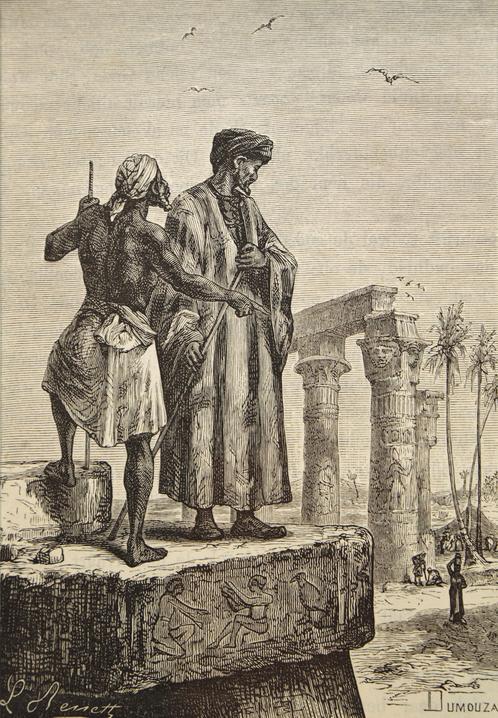
Image: Léon Benett · Public domain · Wikimedia Commons
Exploration
Ibn Battuta sets out from Tangier
14 June 1325 · Tangier
On 14 June 1325 the twenty-one-year-old jurist Ibn Battuta left his native Tangier for the pilgrimage to Mecca.
He went on travelling for almost thirty years and covered an estimated 117,000 kilometres: through North Africa, Arabia, Persia, East Africa, Central Asia, India, the Maldives and China, and later to Andalusia and Mali. Back in Morocco he dictated his memoirs in 1354 and 1355, the Rihla, one of the richest sources on the Islamic world of the fourteenth century.
Key facts
- Date
- 14 June 1325
- Place
- Tangier
- Country
- Morocco
- Category
- Exploration
- Significance
- Lesser-known
Background and run-up
Ibn Battuta was born in Tangier on 24 February 1304 into a family of Islamic legal scholars. His relatives belonged to the Lawata, a Berber tribe, and as a jurist he had been trained in the Maliki school, which predominated in North Africa. Morocco was then ruled by the Marinids, a Berber dynasty with Fez as its capital. In Islam the pilgrimage to Mecca is a duty for every Muslim who is able to make it. Pilgrims from the Maghreb usually travelled in caravans along the North African coast to Egypt and from there on to the Hejaz.
What happened
His route led through Tlemcen, Béjaïa and Tunis, where he stayed two months, and in the spring of 1326 he reached Alexandria. From Egypt he tried to cross the Red Sea by way of the port of Aydhab, but a rebellion forced him to turn back. He therefore travelled through Syria and went from Damascus with a caravan to Medina and Mecca, where he completed his first pilgrimage in November 1326. He then made a detour through Iraq and Iran, stayed for some time in Mecca and sailed along the East African coast. By way of Anatolia, the steppes of the Golden Horde and Central Asia he reached the Indus in September 1333.
In Delhi Sultan Muhammad bin Tughluq appointed him qadi, a judge under Islamic law. In 1341 the sultan appointed him leader of an embassy to China, but off Calicut one of the ships sank in a storm. Ibn Battuta then worked as a judge in the Maldives and, according to his account, travelled by way of Ceylon, Bengal and Sumatra to China. On the way back he witnessed the plague in Syria in 1348, and in 1349, on his return to Morocco, he learned that his mother had died a few months earlier. Between 1351 and 1354 he also crossed the Sahara to the empire of Mali, where he met Mansa Suleyman.
Immediate consequences
At the suggestion of the Marinid sultan Abu Inan Faris the scholar Ibn Juzayy wrote down the account that Ibn Battuta dictated to him. It received the title 'A Gift to Those Who Contemplate the Wonders of Cities and the Marvels of Travelling'. In doing so Ibn Juzayy took over passages from the travel account of the twelfth-century Andalusian Ibn Jubayr without naming his source. Historians of the empire of Mali use the description of the court of Mansa Suleyman as one of the few eyewitness accounts of that time. Little is known about the rest of Ibn Battuta's life: he became a judge in Morocco and died in 1368 or 1369.
Legacy and remembrance
In Europe the Rihla became known only in the nineteenth century, after the travellers Ulrich Jasper Seetzen and Johann Burckhardt had acquired abridged manuscripts. From 1853 Charles Defrémery and Beniamino Sanguinetti published a critical edition of the Arabic text with a French translation in four volumes. The English translation that H.A.R. Gibb made for the Hakluyt Society appeared from 1958, and the fourth volume, edited by Charles Beckingham, followed in 1994. The reliability of the account is debated: a journey up the Volga to Bulghar is considered very unlikely, and some scholars doubt whether he visited China.
Timeline
24 February 1304
Ibn Battuta is born in Tangier into a family of legal scholars.
14 June 1325
Ibn Battuta leaves Tangier for the pilgrimage to Mecca.
November 1326
Ibn Battuta completes his first pilgrimage in Mecca.
1341
Sultan Muhammad bin Tughluq appoints Ibn Battuta leader of an embassy to China.
1355
Ibn Juzayy completes the text of the Rihla.
1853
The first volume of the Arabic text with a French translation appears.
On the map
People involved
Sources
- Wikipedia – Ibn Battuta
- The Adventures of Ibn Battuta: A Muslim Traveler of the Fourteenth Century (1986) · Ross E. Dunn
- Encyclopaedia Britannica: Ibn Battuta