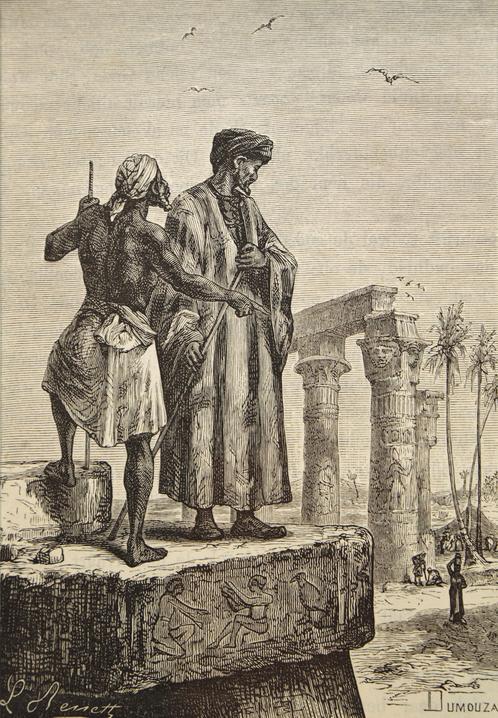
Sources: Léon Benett · Public domain · Wikimedia Commons
Photographs, historical portraits or later depictions; not every person has an authentic portrait.
Ibn Battuta
1304 – 1369
Moroccan traveller and legal scholar who described large parts of Africa and Asia. His Rihla is an important, though not everywhere independently verifiable, source on the fourteenth century.
Background & early life
Ibn Battuta was born in 1304 at Tangier, in present-day Morocco, into a family associated with Islamic jurisprudence. His background lay within the North African Maliki legal tradition. Less information survives about his youth than about the journeys subsequently attributed to him. The legal and religious education presupposed by his account provided access to scholars and officials in different parts of the Islamic world.
In 1325 he left Tangier at the age of twenty-one to undertake the pilgrimage to Mecca. According to his later account, he departed without his parents after saying farewell to them. The journey began many years away from his home region. His social position as an educated Muslim enabled participation in established networks of hospitality, recommendation and patronage, although travel still depended on money, health and political circumstances.
Core activities & thinking
After his first pilgrimage in 1326, he continued through parts of the Middle East and along the East African coast. His descriptions connect religious visits with attention to courts, ports and trading routes. The travel narrative includes several returns to familiar centres and cannot be reduced to a single uninterrupted linear itinerary. Chronological difficulties and borrowed passages also mean that not every stage is equally secure as personal experience.
Around 1333 he reached Delhi and entered the service of Sultan Muhammad bin Tughluq as a judge. His account describes court patronage, rewards and political uncertainty from the perspective of a dependent courtier. He subsequently stayed in places including the Maldives and travelled through South Asia. His legal views influenced descriptions of local customs; these remarks are not straightforwardly neutral records of the societies he visited.
In 1352–1353 he visited the Mali Empire and subsequently returned to Morocco. At the request of the Marinid court, Ibn Juzayy developed his recollections into a book during the 1350s. Usually called the Rihla, it combines travel experience, literary conventions and information from other texts. Descriptions of China and certain other routes are disputed. The work must therefore be examined both as a travel source and as a composite literary production.
Zeitgeist & culture
The fourteenth-century world possessed extensive connections between North Africa, the Middle East, East Africa and Asia. Pilgrimage, commerce and scholarship carried people across political boundaries, while Arabic and shared religious practices could support communication. Legal schools and local customs nevertheless differed considerably. Travellers could encounter recognisable institutions without finding identical societies everywhere; Ibn Battuta's mobility reveals both integration and differences within these networks.
Rulers employed foreign scholars and legal specialists at their courts and could support travel through gifts and commissions. Such patronage offered opportunities but also dependence and risk. Maritime journeys followed commercial routes and seasonal wind patterns, while land routes required protection and supplies. Warfare and plague changed some regions during his travels. Existing connections therefore do not imply that his world was continually safe or politically unified.
Societal impact
His activities as a judge and courtier connected him with local authorities and religious institutions, particularly in Delhi and the Maldives. The extent of his actual influence is known chiefly through his own account and is difficult to measure independently. His presence shows how legal education could support social mobility. It does not demonstrate that he introduced lasting reforms everywhere or fundamentally transformed local traditions.
The Rihla made detailed descriptions available to readers within the scholarly culture in which the book was produced. It provided a Moroccan court audience with information about distant regions and foreign rulers. Its early circulation is less fully traceable than its later fame. His concrete contribution lies in the surviving text and the contacts it reveals, rather than a demonstrable general transformation of the fourteenth-century worldview.
Death & legacy
Little reliable information survives about Ibn Battuta's final years. His death is generally placed around 1368–1369, but the precise date and circumstances are uncertain. Later reports associate him with legal work after his return, without providing a fully verifiable biography. The location identified with his tomb in Tangier belongs to local commemorative tradition and does not, by itself, establish a precise reconstruction of the end of his life.
His travel book is an important source for research into commerce, religion and court life in Africa and Asia. Historians compare it with other texts and material evidence, especially where routes, positions or chronology present difficulties. His judgements about women, religious practices and social order reflect his own background. Distinguishing observation, borrowed passages and narrative construction makes the Rihla useful without treating it as literally reliable everywhere.
Key moments
- Left Tangier in 1325 and reached Mecca in 1326.
- Travelled through parts of the Middle East and along the East African coast.
- Reached Delhi around 1333 and served as a judge under Sultan Muhammad bin Tughluq.
- Travelled via the Maldives and South Asia in the 1340s; parts of his account of China are disputed.
- Visited the Mali Empire in 1352–1353 and returned to Morocco.
- Dictated his travel account to Ibn Juzayy in the 1350s; his death around 1368–1369 is uncertainly dated.
Sources: Wikipedia: Ibn Battuta
Related events
No linked events yet.
Related conflicts
No linked conflicts in the database yet.
Military equipment from this period
- Composite bow (regional variants)Bows, crossbows & ranged weapons
- Arming swordSwords, spears & melee weapons
- LongswordSwords, spears & melee weapons
- Medieval bowBows, crossbows & ranged weapons
- English longbowBows, crossbows & ranged weapons
- Medieval crossbowBows, crossbows & ranged weapons
- Battering ramSiege engines
- Traction trebuchet / mangonelSiege engines
- Counterweight trebuchetSiege engines
- Mongol composite bowBows, crossbows & ranged weapons
- Cavalry sabre (regional models)Swords, spears & melee weapons
- Medieval bombardArtillery
- YariSwords, spears & melee weapons
- HalberdSwords, spears & melee weapons