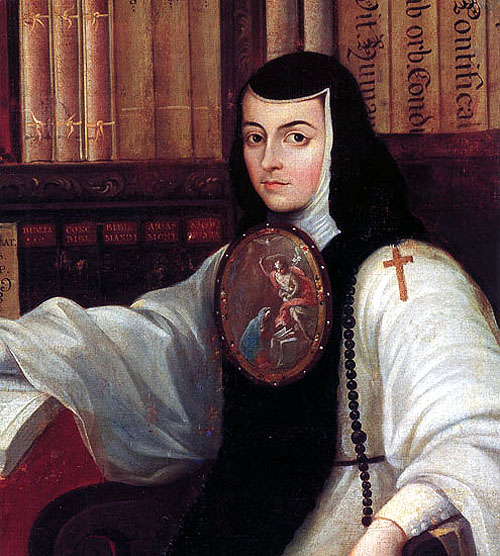
胡安娜·伊內斯·德·拉·克魯斯修女
1648 – 1695
新西班牙(墨西哥)詩人、劇作家和修女,被視為西班牙語巴洛克文學最重要的作家之一。她在《答菲洛特婭修女書》(1691年)中為女性的求學權利辯護。其出生年份存在爭議:1648年或1651年。
生平背景與早年經歷
Juana Inés de Asbaje y Ramírez de Santillana was born in San Miguel Nepantla, at the foot of the Popocatépetl volcano, in the Viceroyalty of New Spain. A baptismal record points to 1648, while her first biographers gave 1651. Her mother, Isabel Ramírez, was a criolla; her father, the Basque captain Pedro Manuel de Asbaje, was not married to her mother and played hardly any role in her life.
Juana grew up on her grandfather's hacienda at Panoayan, where, by her own later account, she went to school with her sister at the age of three and learned to read. She read her grandfather's books and learned Latin, by her own account in twenty lessons. As a child she was sent to relatives in Mexico City.
主要活動與思想
As a teenager Juana became a lady-in-waiting to Leonor Carreto, Marchioness of Mancera and wife of the viceroy. According to her first biographer, the viceroy had her examined by a large number of scholars, who were impressed by her knowledge. Unwilling to marry and wishing to study, she chose the convent: after a brief stay with the Carmelites she took her vows with the Hieronymite nuns in 1669.
In the convent she had a large library and musical and scientific instruments, and received visitors in the parlour. She wrote sonnets, love poems, songs for church feasts, plays such as 'Los empeños de una casa' and the long philosophical poem 'Primero sueño', about the soul's quest for knowledge. Her poem 'Hombres necios' criticises men's double standards towards women.
In 1690 the Bishop of Puebla, Manuel Fernández de Santa Cruz, published without her consent her critique of a sermon by the Portuguese Jesuit António Vieira, together with a letter under the pseudonym 'Sor Filotea de la Cruz' urging her to devote herself to religious matters. In her reply, the 'Respuesta' of 1691, Sor Juana defended women's right to study and teach with examples from the Bible and history.
時代精神與文化
In the 17th century New Spain was a wealthy colony of the Spanish empire, with Mexico City as its centre of government, trade and church. Society was strongly hierarchical, with Spaniards and criollos at the top and Indigenous, African and mixed populations below. For women of the elite, marriage or the convent were the main paths in life.
The Catholic Church and the Inquisition supervised publications and opinions. At the same time Baroque culture was rich in poetry, theatre, music and ceremonies at court and in church. Literature from Spain, such as the work of Góngora and Calderón, was well known in Mexico, and Sor Juana deliberately wrote within that tradition.
社會影響
Thanks to the vicereine María Luisa, Marchioness of La Laguna, her work was published in Spain from 1689 in three volumes, which were reprinted several times. As a result she became known on both sides of the Atlantic during her lifetime as 'the tenth muse'. Her work showed that literature of the highest level was being written in the colonies.
Her defence of women's learning found little direct following in her own time. In the 20th century, however, she became an important figure for feminism and for Mexican national identity, and a favourite subject of literary scholarship in Latin America, Spain and the United States.
逝世與歷史遺產
In 1693–1694 Sor Juana gave up most of her library and instruments and signed a renewal of her vows in her own blood. Whether she was pressured to do so by her confessor or the archbishop, or acted out of personal religious conviction, is disputed among historians. She died on 17 April 1695 in an epidemic while nursing sick sisters.
Octavio Paz's study 'Sor Juana Inés de la Cruz o las trampas de la fe' (1982) brought her life to a wide audience. The former convent of San Jerónimo now houses the Universidad del Claustro de Sor Juana. She has appeared on the Mexican 100-peso banknote since 2020.
重要時刻
- 約1664年成為總督夫人曼塞拉侯爵夫人的侍女,其學識令學者們印象深刻。
- 1667年曾短暫加入加爾默羅會,1669年在墨西哥城聖哲羅姆修道院發願成為修女。
- 創作詩歌、戲劇和宗教作品,其中包括哲理長詩《初夢》。
- 自1689年起,在總督夫人拉古納侯爵夫人瑪麗亞·路易莎的幫助下,其作品在西班牙出版。
- 1691年寫下《答菲洛特婭·德·拉·克魯斯修女書》,為女性求知的權利辯護。
- 1694年放棄了自己的書籍和儀器,1695年在墨西哥城的一場瘟疫中去世。
資料來源: Wikipedia: Juana Inés de la Cruz · Encyclopaedia Britannica: Sor Juana Inés de la Cruz · Wikipedia: Juana Inés de la Cruz (Spaans)
相關事件
暫無關聯事件。
相關戰爭
資料庫中暫無關聯戰爭。
此時期的軍事裝備
- 複合弓(地區變體)弓、弩與遠端武器
- 騎兵軍刀(地區型號)刀劍、長矛與近戰武器
- 克利奇刀刀劍、長矛與近戰武器
- 火繩槍(地區型號)槍械與機槍
- 步兵長矛刀劍、長矛與近戰武器
- 日本刀刀劍、長矛與近戰武器
- 槍(日本長槍)刀劍、長矛與近戰武器
- 種子島火繩槍槍械與機槍
- 燧發槍(地區型號)槍械與機槍
- 攻城炮(近代早期變體)火炮
- 戟刀劍、長矛與近戰武器