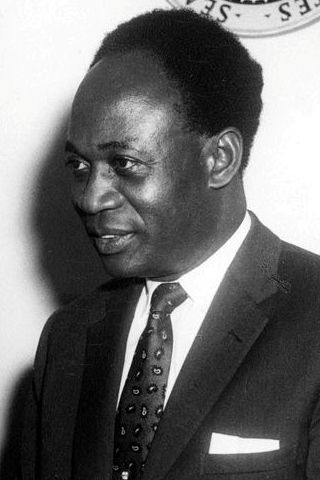
Kwame Nkrumah
1909 – 1972
Ghanaian politician and Pan-Africanist who led the Gold Coast to independence in 1957 and became the first prime minister and later president of Ghana. His rule included large-scale development plans, but also a one-party state and detention without trial; in 1966 he was removed by a coup.
生平背景與早年經歷
Kwame Nkrumah was born in Nkroful, a village in the Nzema area in the south-west of the Gold Coast. He himself gave 21 September 1909 as his date of birth; his mother later gave 1912 as the year. His father was a goldsmith, his mother a fishmonger and trader. As a child he was called Francis Nwia-Kofi; he adopted the name Kwame only in 1945.
He attended a Catholic mission school in Half Assini and was given a place at a teacher-training college in Accra, the later Achimota College. There, through Kwegyir Aggrey, he became acquainted with the ideas of Marcus Garvey and W. E. B. Du Bois. In 1935 he left for the United States to study.
主要活動與思想
In the United States he earned a bachelor's degree in economics and sociology at Lincoln University in 1939, a bachelor's in theology in 1942 and, at the University of Pennsylvania in 1943, master's degrees in philosophy and education. He made a living with odd jobs and preached in Black Presbyterian churches. In 1945 he went to London.
With George Padmore he organised the Fifth Pan-African Congress in Manchester in October 1945, which aimed to replace colonialism with a federation of African states, preferably without violence. In late 1947 Nkrumah returned to the Gold Coast as general secretary of the United Gold Coast Convention. After a break with its leadership he founded the Convention People's Party (CPP) on 12 June 1949.
After the 'Positive Action' of January 1950, a general strike, he was arrested and convicted. In the elections of February 1951 the CPP won 34 of the 38 contested seats and Nkrumah was elected from prison; he was released on 12 February. He became leader of government business and in 1952 prime minister of the Gold Coast.
As head of government he had roads, railways and schools built or expanded and began construction of the harbour at Tema. The Gold Coast became independent on 6 March 1957 as Ghana, the first British African territory with majority rule to do so. Nkrumah became the first prime minister of Ghana; in 1960 the country became a republic and he its president.
時代精神與文化
After the Second World War decolonisation got under way, and in Africa and the diaspora a Pan-African movement emerged that aimed at cooperation and unity of the continent. The Gold Coast was a rich cocoa exporter and politically more developed than Britain's other colonies in West Africa. In 1946 Africans for the first time gained a majority in the legislative council.
Ghana's independence fell in the Cold War. Nkrumah argued for a non-aligned course and for socialism, which he held best suited African values; in 1961 Ghana was a co-founder of the Non-Aligned Movement. He also received aid from the West, including from the United States and the World Bank, but Western governments were wary of his policies.
社會影響
Ghana's independence served as an example for other colonies. Nkrumah held the Conference of Independent African States in Accra in April 1958 and the All-African Peoples' Conference in December 1958. In 1960 he formed the Union of African States with Guinea and Mali, and he played a role in founding the Organisation of African Unity (1963), which remained an association of sovereign states.
The Volta River Project with the Akosombo Dam was central to his economic programme. The dam was built with help from the United States, Israel and the World Bank and was opened by Nkrumah on 22 January 1966. Financing led to debts and higher taxes on cocoa farmers, which sharpened regional tensions. The number of pupils rose from about 200,000 to 500,000 between 1951 and 1956.
In 1958 he had the Preventive Detention Act passed, which allowed people to be held for up to five years without charge or trial. After acquittals in a 1962 trial he dismissed the chief judge of the state security court and allowed a retrial. In 1964 a referendum made the CPP the only permitted party, with Nkrumah as president for life; observers called the 99.91 per cent result implausible.
逝世與歷史遺產
In February 1966, while Nkrumah was on a state visit to China, his government was overthrown by the army and police. The conspirators formed the National Liberation Council under Joseph Ankrah and ruled for three years. Involvement of the CIA has been claimed, including by former staff, but has never been verified.
Nkrumah then lived in Conakry, the capital of Guinea, where he received honours. He died on 27 April 1972 in Bucharest of an illness; his body was returned to Ghana. A mausoleum and memorial park in Accra commemorate him, and 21 September is a national day of remembrance in Ghana.
His legacy is judged differently. He is regarded as a leading voice of Pan-Africanism and was voted 'African of the Millennium' by listeners of the BBC World Service. Supporters point to independence and to the expansion of education and infrastructure; critics point to the one-party state, detention without trial and the burden of debt.
重要時刻
- Studied in the United States from 1935 to 1943, including at Lincoln University and the University of Pennsylvania.
- Helped organise the Fifth Pan-African Congress in Manchester in October 1945.
- Founded the Convention People's Party in 1949, won the 1951 elections from prison and became prime minister of the Gold Coast in 1952.
- Led the Gold Coast to independence as Ghana on 6 March 1957 and became president of the new republic in 1960.
- Had the Preventive Detention Act passed in 1958 and established a one-party state in 1964 by referendum, with himself as president for life.
- Opened the Akosombo Dam in January 1966, was removed by a coup in February 1966 and died on 27 April 1972 in Bucharest.
資料來源: Wikipedia: Kwame Nkrumah · Wikipedia: Kwame Nkrumah (Engels) · Wikipedia: Akosombo Dam
相關事件
暫無關聯事件。
相關戰爭
資料庫中暫無關聯戰爭。
此時期的軍事裝備
- 虎式I型坦克坦克
- T-34/76坦克坦克
- 四號坦克H型坦克
- 騎兵軍刀(地區型號)刀劍、長矛與近戰武器
- 加特林機槍槍械與機槍
- 馬蒂尼-亨利步槍槍械與機槍
- 莫辛-納甘M1891步槍(系列)槍械與機槍
- 有坂30式步槍槍械與機槍
- 馬克沁機槍(系列)槍械與機槍
- 三笠號戰列艦軍艦
- 李-恩菲爾德步槍(SMLE/4號)槍械與機槍
- 98式步槍槍械與機槍
- 維克斯機槍槍械與機槍
- 劉易斯機槍槍械與機槍
- 1897式75毫米野戰炮火炮
- 米爾斯手榴彈(系列)爆炸物與手榴彈
- I型坦克坦克
- IV型坦克坦克
- 鐵公爵號(HMS Iron Duke)軍艦
- Karabiner 98k步槍槍械與機槍
- MG 34通用機槍槍械與機槍
- MG 42通用機槍槍械與機槍
- PPSh-41衝鋒槍槍械與機槍
- M1加蘭德步槍槍械與機槍
- 湯普森衝鋒槍(M1928/M1系列)槍械與機槍
- 斯登衝鋒槍槍械與機槍
- 勃朗寧M1919機槍槍械與機槍
- 有坂99式步槍槍械與機槍
- M4謝爾曼坦克(系列)坦克
- 黑豹坦克(系列)坦克
- 三菱A6M零式戰鬥機(系列)飛機與直升機
- 企業號航空母艦(CV-6)軍艦
- AK-47/AKM系列步槍槍械與機槍
- M16步槍(系列)槍械與機槍
- M60通用機槍槍械與機槍
- RPG-7火箭筒弓、弩與遠端武器
- 貝爾UH-1“伊洛魁”直升機(系列)飛機與直升機
- T-54/T-55坦克系列坦克
- 無畏號戰列艦(1906年)軍艦
- 超級馬林“噴火”式戰鬥機(I型資料)飛機與直升機
- 大和號戰列艦軍艦
- 密蘇里號戰列艦(BB-63)軍艦
- 福克Dr.I飛機與直升機
- 索普威思駱駝飛機與直升機
- 梅塞施密特Bf 109(G-6型資料)飛機與直升機
- 北美P-51野馬(P-51D型資料)飛機與直升機
- 波音B-17空中堡壘(B-17G型資料)飛機與直升機
- 梅塞施密特Me 262飛機與直升機
- 聯合B-24解放者飛機與直升機
- 雷諾FT坦克
- 虎II(虎王)坦克
- KV-1坦克
- IS-2坦克
- 三號突擊炮(G型資料)其他裝甲車輛
- 俾斯麥號軍艦
- StG 44突擊步槍槍械與機槍
- MP 40衝鋒槍槍械與機槍
- 柯爾特M1911手槍槍械與機槍
- 魯格P08手槍槍械與機槍
- 勃朗寧自動步槍(M1918)槍械與機槍
- 大貝爾塔(42釐米M型臼炮)火炮
- 巴黎炮火炮
- 8.8釐米Flak 18/36/37高射炮火炮
- 喀秋莎(BM-13)火炮
- 莫洛托夫雞尾酒(燃燒瓶)爆炸物與手榴彈