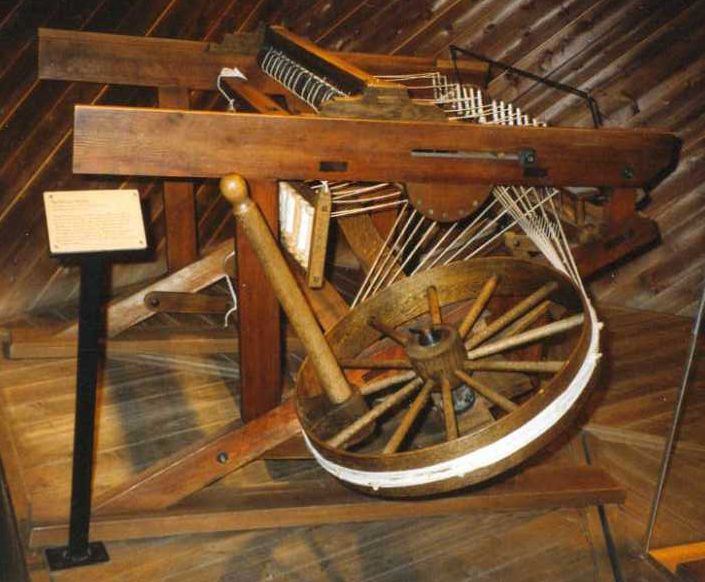
Model of a spinning jenny in the Museum of Early Industrialisation in Wuppertal.
Image: Markus Schweiß · CC BY-SA 3.0 · Wikimedia Commons
Spinning machines and the power loom
James Hargreaves, Richard Arkwright, Samuel Crompton, Edmund Cartwright · c. 1764 (spinning jenny) – 1785 (power loom)
Between 1764 and 1785 a few inventors in England mechanised the spinning and weaving of cotton; in mills, water power and later steam drove hundreds of spindles at once.
Key facts
- Date
- c. 1764 (spinning jenny) – 1785 (power loom)
- Inventors and discoverers
- James Hargreaves
- Richard Arkwright
- Samuel Crompton
- Edmund Cartwright
- Place
- Cromford (Derbyshire); the spinning jenny originated in Stanhill (Lancashire)
- Theme
- Tools and materials
- Kind
- Invention
What it is
Spinning draws out a loose strand of fibres and twists it into yarn. James Hargreaves's spinning jenny (Stanhill, c. 1764) let one spinner work first eight and later dozens of spindles at once, but its yarn was not strong. Richard Arkwright's water frame (patented 1769) drew out the fibres between rollers turning at different speeds and was driven by a water wheel; in 1771 he opened a spinning mill for it at Cromford. Samuel Crompton's 'mule' (1779) combined both principles and produced fine, strong yarn. In 1785 Edmund Cartwright patented a loom driven by machinery. From 1785 spinning mills were also driven by steam engines.
Who came first?
John Kay had already sped up weaving in 1733 with the flying shuttle, which made yarn scarce. Arkwright's patent was annulled in 1785, partly because Thomas Highs and the clockmaker John Kay had worked on the spinning machine. Cartwright's first looms were unreliable; improvements by others made power looms widely usable in the early 19th century.
Impact
Cotton yarn and cloth became much cheaper and production moved from homes to factories, with long working days and much child labour. Handloom weavers lost their income; Luddites destroyed machines between 1811 and 1816. Demand for raw cotton rose sharply and was largely met by plantations in the southern United States, worked by enslaved people.
The chain on the map
Led to
Later breakthroughs in this section that build on this one.
