
Reconstruction of the first radio transmitter Marconi built in 1895 (published in 1926).
Image: Guglielmo Marconi · Public domain · Wikimedia Commons
Radio (wireless telegraphy)
Guglielmo Marconi, Jagadish Chandra Bose, Alexander Popov · 1895–1901
From 1895 Guglielmo Marconi developed a system for sending Morse code messages without wires using radio waves. In December 1901 he reported receiving signals in Newfoundland that had been sent across the Atlantic Ocean.
Key facts
- Date
- 1895–1901
- Inventors and discoverers
- Guglielmo Marconi
- Jagadish Chandra Bose
- Alexander Popov
- Place
- Pontecchio near Bologna (Villa Griffone), Italy
- Kind
- Invention
What it is
A radio transmitter uses an electric spark, later electronic circuits, to create electromagnetic waves that travel at the speed of light. An antenna at the receiver picks up a small part of them; a detector, in the early days a tube filled with metal filings (the coherer), turns this into a signal. Marconi began his experiments on his family's estate near Bologna. In the summer of 1895 he greatly increased the range by using a tall antenna and earthing both transmitter and receiver. In 1896 he applied for a patent in London, and in 1897 he founded a company. On 12 December 1901, by his own account, he received the letter S in St. John's, sent from Poldhu in Cornwall; this claim has also been doubted ever since. In 1909 he shared the Nobel Prize in Physics with Ferdinand Braun.
Who came first?
Radio waves were demonstrated in the 1880s by Heinrich Hertz, building on the theory of James Clerk Maxwell. Many people then worked on transmitters and receivers, among them Oliver Lodge, Alexander Popov (1895) and Jagadish Chandra Bose, who sent signals with very short waves through walls in Calcutta in 1895. Marconi built the first practical system of wireless telegraphy. In 1943 the US Supreme Court invalidated some of his patents because of earlier work by Nikola Tesla and Lodge, among others.
Impact
Wireless telegraphy was first used by navies and shipping; when the Titanic sank in 1912, distress messages were sent by radio. With vacuum tubes, speech and music could also be transmitted from the early 20th century, and in the 1920s radio broadcasting became a mass medium. Radio waves also underlie television, radar, mobile telephony, Wi-Fi and satellite links.
The chain on the map
Elsewhere on the site
Builds on
Earlier breakthroughs this one builds on.
 Geof Sheppard · CC BY-SA 4.0 · Wikimedia CommonsFrom the 1830s messages were sent over wires by electric current; in Britain and the United States this gave rise to the first telegraph networks.Writing and communicationInventionGeof Sheppard · CC BY-SA 4.0 · Wikimedia Commons
Electric telegraph
1833 · Göttingen (Gauss and Weber); the first public lines in Britain and the USCarl Friedrich Gauss, Wilhelm Weber, William Fothergill Cooke and Charles Wheatstone, Samuel Morse and Alfred Vail Unknown author · Public domain · Wikimedia CommonsIn 1820 Hans Christian Ørsted saw that an electric current deflects a compass needle: electricity and magnetism turned out to be linked.Astronomy and physicsDiscoveryUnknown author · Public domain · Wikimedia Commons
Electromagnetism
1820 · CopenhagenHans Christian Ørsted, André-Marie Ampère
Led to
Later breakthroughs in this section that build on this one.
 Orrin Dunlap, Jr. · Public domain · Wikimedia CommonsOn 26 January 1926 John Logie Baird showed in London moving images of faces transmitted by his mechanical television system. Around the same time others in Japan and the US developed fully electronic systems.Writing and communicationInventionOrrin Dunlap, Jr. · Public domain · Wikimedia Commons
Television
1925–1927 · London (Soho), United KingdomJohn Logie Baird, Kenjiro Takayanagi, Philo Farnsworth, Vladimir Zworykin Unknown author · Public domain · Wikimedia CommonsDuring the Second World War the first electronic digital computers were built: Colossus at Bletchley Park (1943–1944) to break encrypted German messages and ENIAC in Philadelphia (1945) for ballistics calculations.Mathematics and computingInventionUnknown author · Public domain · Wikimedia Commons
Electronic computer
1943–1946 · Bletchley Park, United KingdomTommy Flowers, Max Newman, J. Presper Eckert, John Mauchly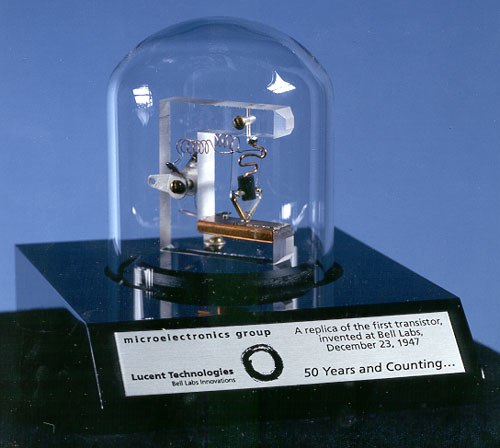 U.S. federal government · Public domain · Wikimedia CommonsIn December 1947 John Bardeen and Walter Brattain built the first working transistor at Bell Labs, an amplifier and switch made of semiconductor material. Transistors replaced the vacuum tube in almost all electronics.Mathematics and computingInventionU.S. federal government · Public domain · Wikimedia Commons
Transistor
1947 · Murray Hill (New Jersey), Bell Labs, United StatesJohn Bardeen, Walter Brattain, William Shockley NSSDC, NASA · Public domain · Wikimedia CommonsOn 4 October 1957 the Soviet Union launched Sputnik 1, the first artificial satellite. The 58-centimetre metal sphere circled the Earth in about 96 minutes and sent out radio signals for three weeks.Transport and navigationInventionNSSDC, NASA · Public domain · Wikimedia Commons
Artificial satellite (Sputnik 1)
1957 · Baikonur (Tyuratam), KazakhstanSergei Korolev, Mikhail Tikhonravov Rico Shen · CC BY-SA 3.0 · Wikimedia CommonsOn 3 April 1973 Martin Cooper of Motorola made the first public call on a handheld mobile phone in New York. Ten years later the DynaTAC 8000X went on sale.Writing and communicationInventionRico Shen · CC BY-SA 3.0 · Wikimedia Commons
Mobile phone
1973–1983 · New York (Sixth Avenue, Manhattan), United StatesMartin Cooper, John F. Mitchell