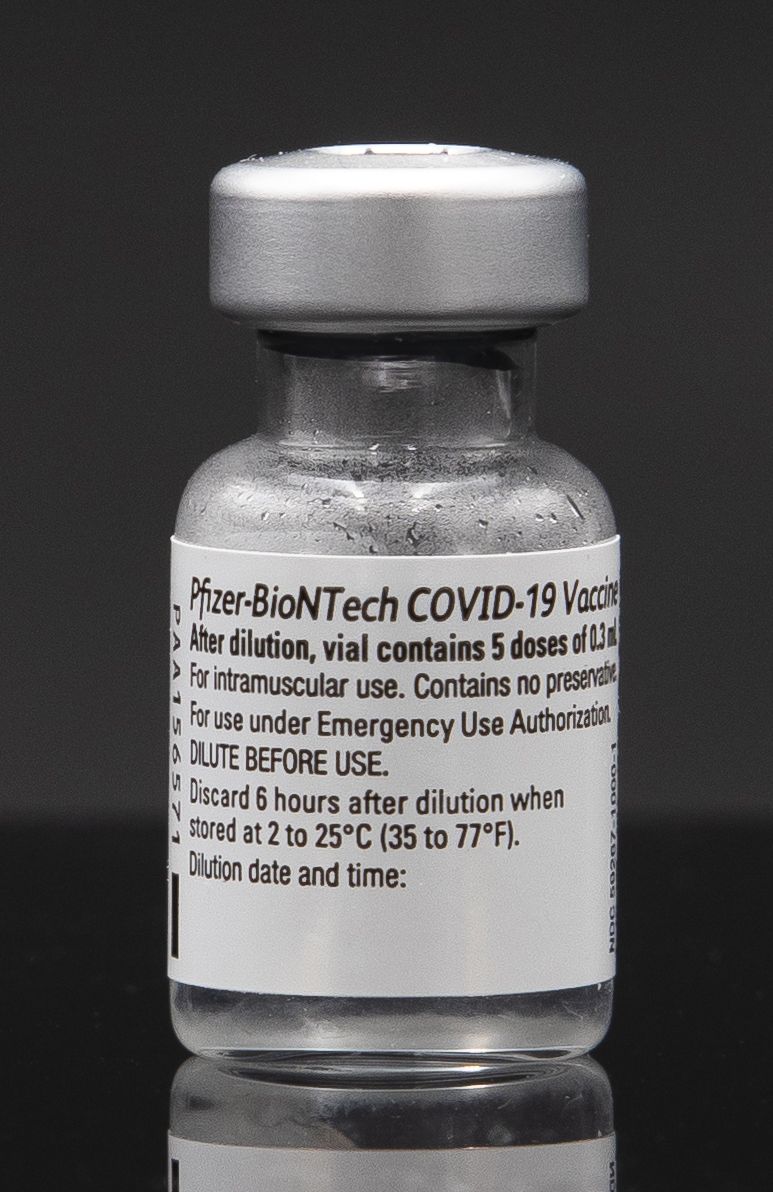
Vial of the BioNTech and Pfizer COVID-19 vaccine (December 2020).
Image: Arne Müseler · CC BY-SA 3.0 de · Wikimedia Commons
mRNA vaccines
Katalin Karikó, Drew Weissman, Uğur Şahin, Özlem Türeci · 2005–2020
In 2005 Katalin Karikó and Drew Weissman discovered how mRNA can be modified so that the immune system does not react strongly to it. On that basis, vaccines against COVID-19 were developed within a year in 2020.
Key facts
- Date
- 2005–2020
- Inventors and discoverers
- Katalin Karikó
- Drew Weissman
- Uğur Şahin
- Özlem Türeci
- Place
- Philadelphia (University of Pennsylvania), United States
- Theme
- Medicine and health
- Kind
- Technique
What it is
mRNA (messenger RNA) is a molecule that carries the instruction to make a protein within the cell. An mRNA vaccine contains the instruction for a harmless part of a pathogen, such as the spike protein of the coronavirus. Body cells make that protein for a short time, after which the immune system forms antibodies and immune cells against it; the mRNA is then broken down and does not enter the DNA. For a long time injected mRNA caused inflammation and was broken down quickly. Karikó and Weissman discovered that replacing the building block uridine with pseudouridine largely solves this problem. Because an mRNA vaccine can be designed quickly once a virus's genetic code is known, BioNTech/Pfizer and Moderna were able to produce effective vaccines within a year in 2020.
Who came first?
mRNA vaccines are the result of decades of research by many groups. As early as 1990 mRNA was injected into mice to make them produce proteins, and fatty droplets (lipid nanoparticles) to package mRNA were developed in Canada, among other places. Karikó and Weissman's discovery made the mRNA less inflammatory. The COVID-19 vaccines were developed by BioNTech, founded by Uğur Şahin and Özlem Türeci, together with Pfizer, and by Moderna.
Impact
The BioNTech and Pfizer vaccine was the first to be approved, in the United Kingdom on 2 December 2020. Billions of doses of mRNA vaccines were given worldwide. Karikó and Weissman received the Nobel Prize in Physiology or Medicine in 2023. The technique is being studied for vaccines against other infectious diseases and for cancer treatments.
The chain on the map
Elsewhere on the site
Builds on
Earlier breakthroughs this one builds on.
 Wellcome Collection · CC BY 4.0 · Wikimedia CommonsIn 1796 Edward Jenner inoculated a boy with material from a cowpox pustule and showed that this protected against smallpox; it became the first vaccine.Medicine and healthTechniqueWellcome Collection · CC BY 4.0 · Wikimedia Commons
Smallpox vaccine
1796 · Berkeley (Gloucestershire)Edward Jenner Alkivar · Public domain · Wikimedia CommonsIn April 1953 James Watson and Francis Crick published a model of DNA as a double helix: two strands winding around each other, joined by fixed base pairs. The model relied on X-ray research by Rosalind Franklin and others.Chemistry and biologyDiscoveryAlkivar · Public domain · Wikimedia Commons
Structure of DNA (double helix)
1953 · Cambridge (Cavendish Laboratory), United KingdomJames Watson, Francis Crick, Rosalind Franklin, Maurice Wilkins, Raymond Gosling