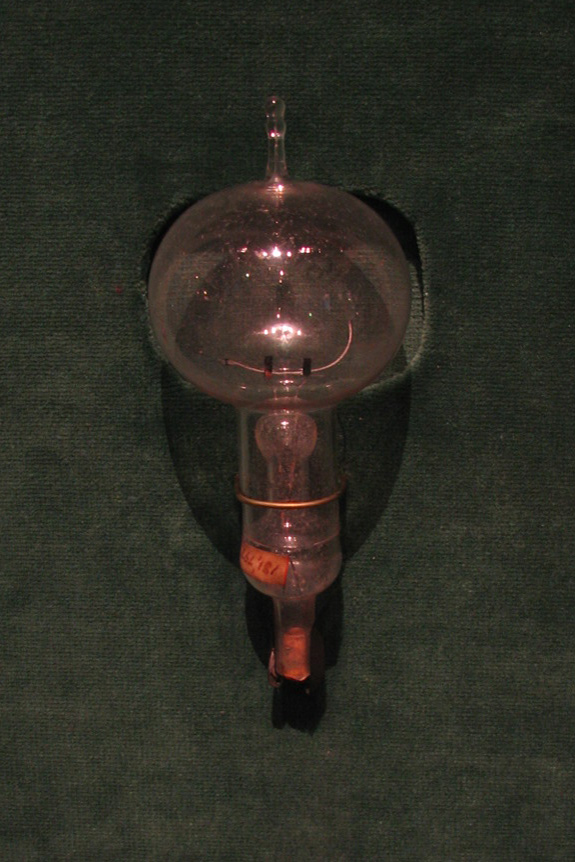
An Edison carbon-filament lamp, described as dating from 1879 and coming from his workshop at Menlo Park.
Image: Terren · CC BY 2.0 · Wikimedia Commons
Incandescent light bulb
Thomas Edison, Joseph Swan, Lewis Latimer · 1879–1880
Thomas Edison and Joseph Swan independently developed a light bulb with a carbon filament in an evacuated glass bulb that lasted long enough for use in homes and buildings.
Key facts
- Date
- 1879–1880
- Inventors and discoverers
- Thomas Edison
- Joseph Swan
- Lewis Latimer
- Place
- Menlo Park (New Jersey), United States
- Theme
- Energy and power
- Kind
- Invention
What it is
In an incandescent lamp an electric current flows through a thin filament that becomes hot enough to give off light. In air such a filament burns up quickly, so it is enclosed in a glass bulb from which the air has been pumped out. The difficulty was finding a filament that lasted. Swan had worked on lamps with carbon filaments since the 1850s and made them usable in the late 1870s thanks to better vacuum pumps. Edison's team at Menlo Park tested thousands of materials; on 22 October 1879 a lamp with a filament of carbonised cotton thread burned for more than thirteen hours, and later filaments of carbonised Japanese bamboo lasted over 1,200 hours. Edison also designed a system of power stations, mains, meters and switches.
Who came first?
The light bulb had no single inventor. From the 1840s Warren de la Rue, Alexander Lodygin (Russian patent 1874) and Henry Woodward and Mathew Evans (Canadian patent 1874, later bought by Edison), among others, built working lamps. Joseph Swan demonstrated a lamp with a carbon filament in Newcastle in early 1879, and Edison did so in Menlo Park in October 1879. In Britain their companies merged in 1883. Lewis Latimer improved the manufacture of carbon filaments.
Impact
Within a few decades electric light replaced gas and oil lamps in cities, factories and homes, and the demand for electricity led to the construction of power grids. From 1904 tungsten filaments were used. Because an incandescent bulb turns less than 5 per cent of its energy into visible light, it has largely been replaced by LED lamps in many countries since the 2010s.
The chain on the map
Elsewhere on the site
Builds on
Earlier breakthroughs this one builds on.
 GuidoB · CC BY-SA 3.0 · Wikimedia CommonsAlessandro Volta stacked discs of zinc and copper separated by brine-soaked cardboard and so obtained the first source of a continuous electric current.Energy and powerInventionGuidoB · CC BY-SA 3.0 · Wikimedia Commons
Electric battery (voltaic pile)
1799 · Como and Pavia (Lombardy)Alessandro Volta Unknown author · Public domain · Wikimedia CommonsIn 1831 Michael Faraday discovered that a changing magnetic field produces an electric current; this principle underlies generators and transformers.Energy and powerDiscoveryUnknown author · Public domain · Wikimedia Commons
Electromagnetic induction
1831 · Royal Institution, LondonMichael Faraday, Joseph Henry
Led to
Later breakthroughs in this section that build on this one.
