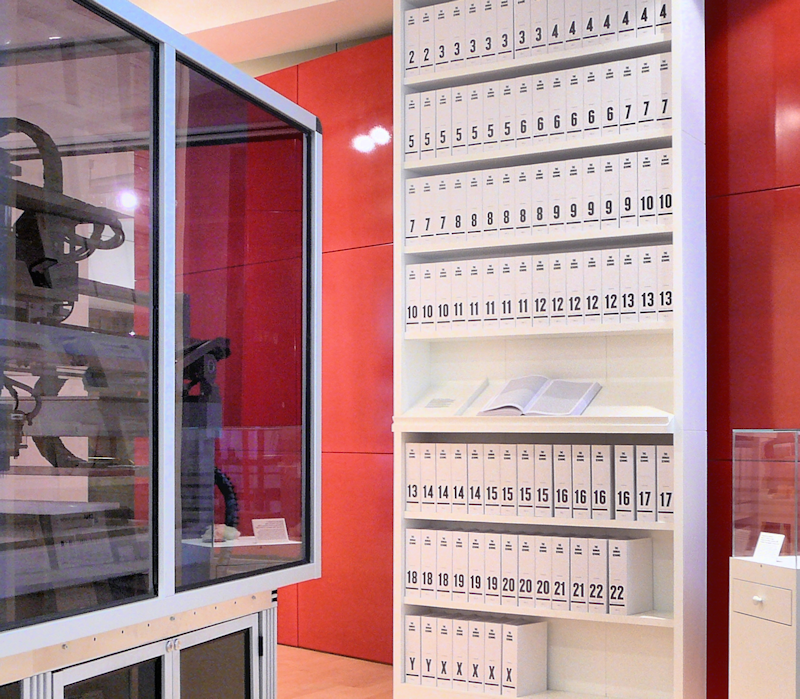
The first printout of the human genome in book form, more than a hundred volumes, at the Wellcome Collection in London.
Image: Russ London · CC BY-SA 3.0 · Wikimedia Commons
Human Genome Project
International Human Genome Sequencing Consortium, Francis Collins, J. Craig Venter (Celera Genomics) · 1990–2003
Between 1990 and 2003 researchers in six countries determined the order of the more than three billion base pairs of human DNA. The project was completed in 2003, covering about 92 per cent of the genome.
Key facts
- Date
- 1990–2003
- Inventors and discoverers
- International Human Genome Sequencing Consortium
- Francis Collins
- J. Craig Venter (Celera Genomics)
- Place
- Bethesda (National Institutes of Health), United States
- Kind
- Discovery
What it is
The genome is the complete set of DNA of an organism. The project aimed to record the order of the bases A, C, G and T in human DNA and to map all the genes. To do so, the DNA was cut into pieces that were read with Frederick Sanger's sequencing method and then put back in the right order by computers. Automated sequencing machines and faster computers made the work in the 1990s much faster than expected. A first rough draft was announced in June 2000 and published in February 2001. The project cost about 2.7 billion dollars. Humans turned out to have about 20,000 protein-coding genes, fewer than expected.
Who came first?
The project was a collaboration of research institutes in the US, Britain, France, Germany, Japan and China, funded by the US government and the British Wellcome Trust, among others. From 1998 J. Craig Venter's company Celera Genomics worked on its own, competing version. The 2003 sequence was not complete; only in 2022 did the Telomere-to-Telomere consortium publish an almost complete sequence.
Impact
The data were made freely available and underpin research into hereditary diseases, cancer and human evolution and migration. The cost of reading a genome fell sharply, to a few hundred dollars in the 2020s. The project also led to debates about privacy, discrimination based on genetic data and the use of DNA databases.
The chain on the map
Elsewhere on the site
Builds on
Earlier breakthroughs this one builds on.
 Alkivar · Public domain · Wikimedia CommonsIn April 1953 James Watson and Francis Crick published a model of DNA as a double helix: two strands winding around each other, joined by fixed base pairs. The model relied on X-ray research by Rosalind Franklin and others.Chemistry and biologyDiscoveryAlkivar · Public domain · Wikimedia Commons
Structure of DNA (double helix)
1953 · Cambridge (Cavendish Laboratory), United KingdomJames Watson, Francis Crick, Rosalind Franklin, Maurice Wilkins, Raymond Gosling Unknown author · Public domain · Wikimedia CommonsDuring the Second World War the first electronic digital computers were built: Colossus at Bletchley Park (1943–1944) to break encrypted German messages and ENIAC in Philadelphia (1945) for ballistics calculations.Mathematics and computingInventionUnknown author · Public domain · Wikimedia Commons
Electronic computer
1943–1946 · Bletchley Park, United KingdomTommy Flowers, Max Newman, J. Presper Eckert, John Mauchly
Led to
Later breakthroughs in this section that build on this one.
 Synpath (structure PDB 4OO8: Nishimasu, Ishitani, Nureki) · CC0 · Wikimedia CommonsIn 2012 Jennifer Doudna and Emmanuelle Charpentier showed that the bacterial defence system CRISPR-Cas9 can be used to cut DNA at a chosen site. This makes it much simpler to modify genes.Chemistry and biologyTechniqueSynpath (structure PDB 4OO8: Nishimasu, Ishitani, Nureki) · CC0 · Wikimedia Commons
CRISPR-Cas9 gene editing
2012 · Berkeley (University of California), United StatesJennifer Doudna, Emmanuelle Charpentier, Francisco Mojica, Virginijus Šikšnys, Feng Zhang John Jumper et al · CC BY 4.0 · Wikimedia CommonsGoogle DeepMind's program AlphaFold predicts the three-dimensional shape of a protein from its amino acid sequence. In a 2020 competition it did so for many proteins almost as accurately as laboratory measurements.Chemistry and biologyInventionJohn Jumper et al · CC BY 4.0 · Wikimedia Commons
AlphaFold (protein structure prediction)
2020–2021 · London (Google DeepMind), United KingdomDemis Hassabis, John Jumper, Google DeepMind team