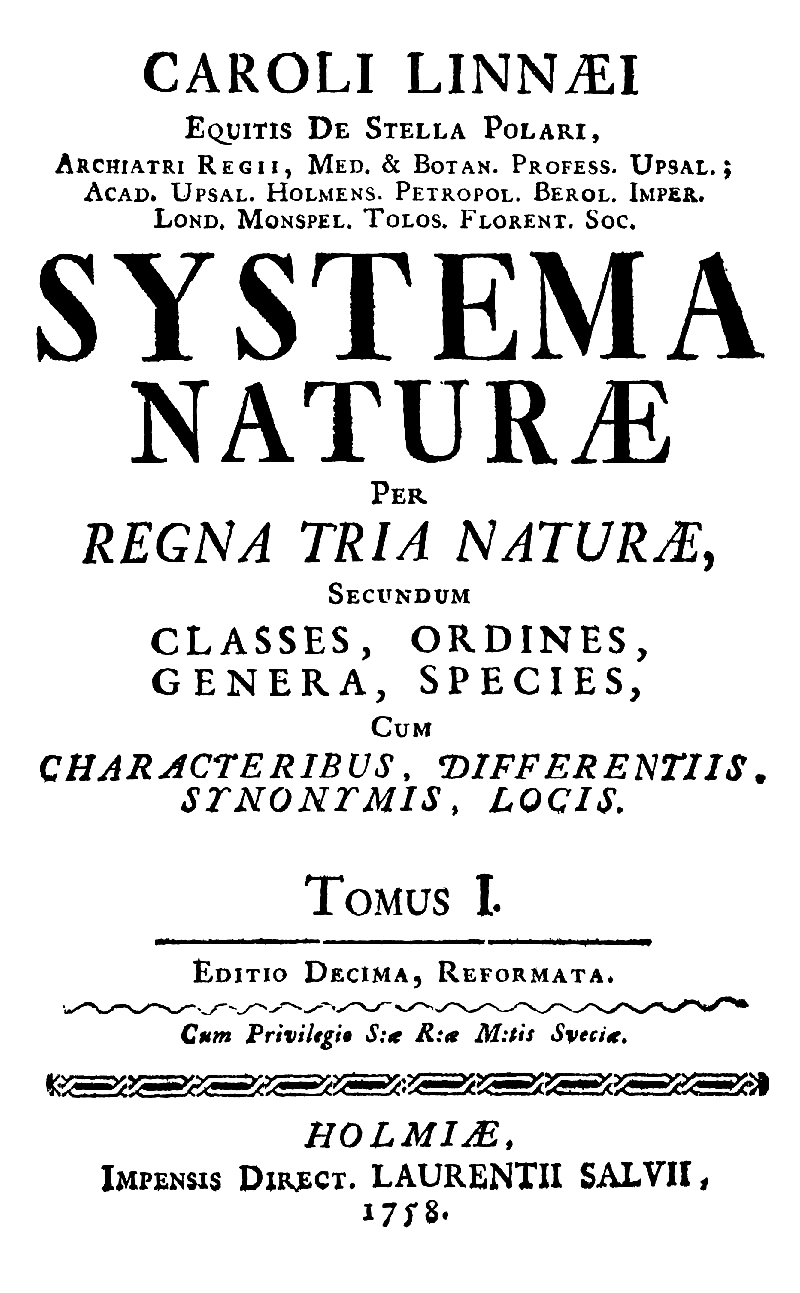
Title page of the tenth edition of Systema naturae (Stockholm, 1758), the starting point of zoological nomenclature.
Image: Carl Linnaeus · Public domain · Wikimedia Commons
Biological classification and naming (Linnaeus)
Carl Linnaeus · 1735 (Systema naturae); two-part names in 1753 and 1758
Carl Linnaeus arranged plants and animals in a fixed hierarchy and gave every species a two-part Latin name, such as Homo sapiens.
Key facts
- Date
- 1735 (Systema naturae); two-part names in 1753 and 1758
- Inventors and discoverers
- Place
- Uppsala (first edition printed in Leiden)
- Kind
- Technique
What it is
Linnaeus published the first version of Systema naturae in 1735 in Leiden, where he was staying at the time: an eleven-page overview dividing nature into three kingdoms (plants, animals and minerals), each subdivided into classes, orders, genera and species. He classified plants by the number and position of their stamens and pistils, an artificial but easy-to-use system. Before him, species often had long descriptive Latin names. In Species plantarum (1753) and the tenth edition of Systema naturae (1758), with about 4,400 animal species, he consistently used a short two-part name: genus and species. In 1758 he gave humans the name Homo sapiens. His division of humans into varieties with ascribed character traits is now rejected as unscientific.
Who came first?
Ranked classification of living things goes back to Aristotle. Caspar Bauhin already used many two-part plant names in his Pinax (1623), and John Ray developed a concept of species. Linnaeus turned the two-part name into a consistently applied rule.
Impact
The years 1753 and 1758 are still the official starting points of botanical and zoological nomenclature. Linnaeus's students collected species around the world. His classification of plants by stamens was replaced by natural systems, and since Darwin classification has reflected relationship by descent; the two-part naming system remained.
The chain on the map
Elsewhere on the site
Led to
Later breakthroughs in this section that build on this one.
 Alexander von Humboldt · CC0 · Wikimedia CommonsOn Chimborazo, Alexander von Humboldt and Aimé Bonpland mapped how vegetation changes with altitude and climate, one of the foundations of biogeography.Chemistry and biologyTheoryAlexander von Humboldt · CC0 · Wikimedia Commons
Humboldt's geography of plants
1802 · Chimborazo (Andes)Alexander von Humboldt, Aimé Bonpland John Murray, Publisher · Public domain · Wikimedia CommonsCharles Darwin and Alfred Russel Wallace explained how species change: individuals with inherited traits that suit their environment better leave more offspring on average.Chemistry and biologyTheoryJohn Murray, Publisher · Public domain · Wikimedia Commons
Evolution by natural selection
1858–1859 · Down House, Downe (Kent), United KingdomCharles Darwin, Alfred Russel Wallace