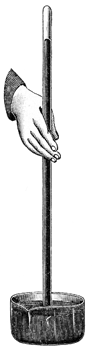
Diagram of Torricelli's experiment: a tube of mercury inverted in a dish of mercury (from a 1912 physics textbook).
Image: Carhart, Henry; Chute, Horatio · Public domain · Wikimedia Commons
Barometer
Evangelista Torricelli, Blaise Pascal, Florin Périer · 1643–1644; Puy de Dôme experiment in 1648
Evangelista Torricelli showed that the air exerts a pressure that can support a column of mercury about 76 centimetres high in a tube.
Key facts
- Date
- 1643–1644; Puy de Dôme experiment in 1648
- Inventors and discoverers
- Evangelista Torricelli
- Blaise Pascal
- Florin Périer
- Place
- Florence (Grand Duchy of Tuscany)
- Theme
- Time and measurement
- Kind
- Invention
What it is
Pump makers knew that a suction pump cannot raise water higher than about ten metres. Torricelli, who had succeeded Galileo as court mathematician in Florence, filled a glass tube about a metre long with mercury and set it upside down in a dish of mercury. The column fell to about 76 centimetres, leaving an almost empty space above it. He explained that the weight of the air pressing on the mercury in the dish holds the column in balance, and noted that its height varies slightly from day to day. He described the experiment in 1644 in a letter to Michelangelo Ricci. In 1648 Blaise Pascal had his brother-in-law Florin Périer repeat the experiment on the Puy de Dôme: at the top of the mountain the mercury stood several centimetres lower than at its foot.
Who came first?
Between 1640 and 1644 Gasparo Berti carried out an experiment in Rome with a long water-filled tube, which is regarded as a forerunner. The historian W.E. Knowles Middleton considers 1644 the more likely date of Torricelli's experiment; 1643 was only suggested after his death.
Impact
The experiment refuted the old doctrine that nature does not allow a void and set off research into vacuum and gases, by Otto von Guericke and Robert Boyle among others. The barometer became an instrument for weather forecasting and measuring altitude. The unit torr is named after Torricelli; air pressure is now usually given in hectopascals.
The chain on the map
Led to
Later breakthroughs in this section that build on this one.
 Robert Boyle · Public domain · Wikimedia CommonsRobert Boyle established that, at constant temperature, the pressure of an enclosed quantity of air is inversely proportional to its volume.Astronomy and physicsDiscoveryRobert Boyle · Public domain · Wikimedia Commons
Boyle's law
1662 · Oxford (England)Robert Boyle, Robert Hooke Chris Allen · CC BY-SA 2.0 · Wikimedia CommonsIn 1712 Thomas Newcomen built a steam engine near Dudley that pumped water from a mine: after the steam in the cylinder condensed, air pressure pushed the piston down.Energy and powerInventionChris Allen · CC BY-SA 2.0 · Wikimedia Commons
Newcomen steam engine
1712 · Coneygree near Dudley Castle (Staffordshire)Thomas Newcomen, John Calley Alexander von Humboldt · CC0 · Wikimedia CommonsOn Chimborazo, Alexander von Humboldt and Aimé Bonpland mapped how vegetation changes with altitude and climate, one of the foundations of biogeography.Chemistry and biologyTheoryAlexander von Humboldt · CC0 · Wikimedia Commons
Humboldt's geography of plants
1802 · Chimborazo (Andes)Alexander von Humboldt, Aimé Bonpland