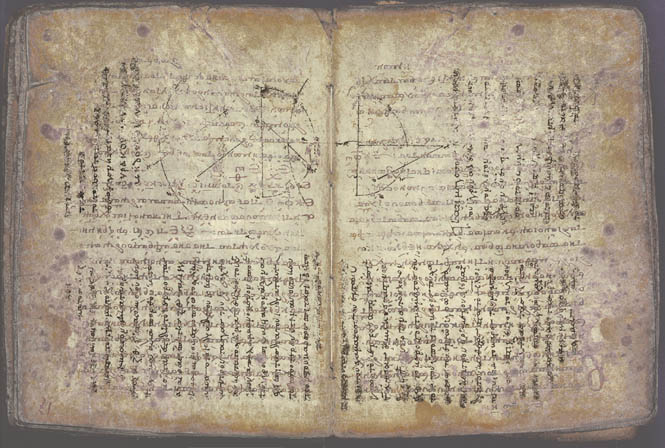
A page of the Archimedes Palimpsest with text from 'On Floating Bodies' beneath later writing
Image: Matthew Kon · Public domain · Wikimedia Commons
Archimedes' principle
Archimedes van Syracuse · 3rd century BCE ('On Floating Bodies')
An object in a fluid experiences an upward force equal to the weight of the fluid it displaces; Archimedes set this out in his work on floating bodies.
Key facts
- Date
- 3rd century BCE ('On Floating Bodies')
- Inventors and discoverers
- Place
- Syracuse, Sicily, Italy
- Kind
- Theory
What it is
In his work on floating bodies Archimedes describes that an object fully or partly immersed in a fluid experiences an upward force equal to the weight of the fluid displaced. An object floats if it weighs less than an equal volume of the fluid. He proved this geometrically, in the style of Euclid, and applied it to the equilibrium of floating bodies shaped like a paraboloid. According to Vitruvius, Archimedes was asked by King Hiero II to find out whether a golden wreath had been adulterated with silver. The only surviving Greek manuscript of the work was hidden in the Archimedes Palimpsest: a 10th-century manuscript whose text was scraped off in the 13th century and overwritten with prayers.
Who came first?
The story that Archimedes found the solution in his bath and cried 'Eureka' comes from Vitruvius, who wrote about two centuries later; it does not appear in Archimedes' own work. How he actually examined the wreath is unknown.
Impact
The principle is the basis of hydrostatics. It explains why ships float, makes density measurements with a hydrostatic balance possible and is used in the design of ships, submarines, floating platforms and hot-air balloons.
The chain on the map
Elsewhere on the site
Builds on
Earlier breakthroughs this one builds on.

Led to
Later breakthroughs in this section that build on this one.
