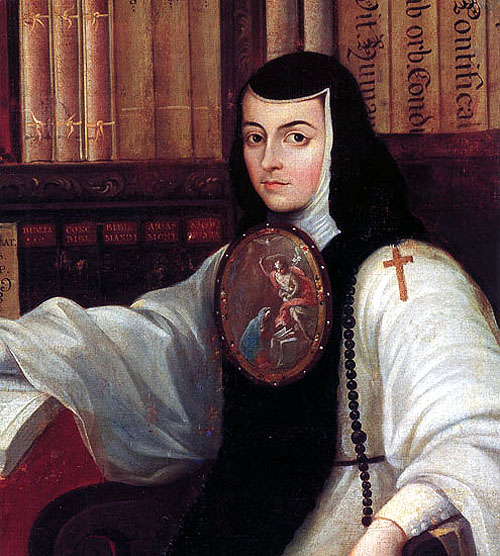
Sources: Miguel Cabrera · Public domain · Wikimedia Commons
Photographs, historical portraits or later depictions; not every person has an authentic portrait.
Sor Juana Inés de la Cruz
1648 – 1695
Mexican poet, playwright and nun from New Spain. She is regarded as one of the most important writers of the Spanish-language Baroque and defended women's right to study in her 'Respuesta a Sor Filotea' (1691). Her year of birth is disputed: 1648 or 1651.
Background & early life
Juana Inés de Asbaje y Ramírez de Santillana was born in San Miguel Nepantla, at the foot of the Popocatépetl volcano, in the Viceroyalty of New Spain. A baptismal record points to 1648, while her first biographers gave 1651. Her mother, Isabel Ramírez, was a criolla; her father, the Basque captain Pedro Manuel de Asbaje, was not married to her mother and played hardly any role in her life.
Juana grew up on her grandfather's hacienda at Panoayan, where, by her own later account, she went to school with her sister at the age of three and learned to read. She read her grandfather's books and learned Latin, by her own account in twenty lessons. As a child she was sent to relatives in Mexico City.
Core activities & thinking
As a teenager Juana became a lady-in-waiting to Leonor Carreto, Marchioness of Mancera and wife of the viceroy. According to her first biographer, the viceroy had her examined by a large number of scholars, who were impressed by her knowledge. Unwilling to marry and wishing to study, she chose the convent: after a brief stay with the Carmelites she took her vows with the Hieronymite nuns in 1669.
In the convent she had a large library and musical and scientific instruments, and received visitors in the parlour. She wrote sonnets, love poems, songs for church feasts, plays such as 'Los empeños de una casa' and the long philosophical poem 'Primero sueño', about the soul's quest for knowledge. Her poem 'Hombres necios' criticises men's double standards towards women.
In 1690 the Bishop of Puebla, Manuel Fernández de Santa Cruz, published without her consent her critique of a sermon by the Portuguese Jesuit António Vieira, together with a letter under the pseudonym 'Sor Filotea de la Cruz' urging her to devote herself to religious matters. In her reply, the 'Respuesta' of 1691, Sor Juana defended women's right to study and teach with examples from the Bible and history.
Zeitgeist & culture
In the 17th century New Spain was a wealthy colony of the Spanish empire, with Mexico City as its centre of government, trade and church. Society was strongly hierarchical, with Spaniards and criollos at the top and Indigenous, African and mixed populations below. For women of the elite, marriage or the convent were the main paths in life.
The Catholic Church and the Inquisition supervised publications and opinions. At the same time Baroque culture was rich in poetry, theatre, music and ceremonies at court and in church. Literature from Spain, such as the work of Góngora and Calderón, was well known in Mexico, and Sor Juana deliberately wrote within that tradition.
Societal impact
Thanks to the vicereine María Luisa, Marchioness of La Laguna, her work was published in Spain from 1689 in three volumes, which were reprinted several times. As a result she became known on both sides of the Atlantic during her lifetime as 'the tenth muse'. Her work showed that literature of the highest level was being written in the colonies.
Her defence of women's learning found little direct following in her own time. In the 20th century, however, she became an important figure for feminism and for Mexican national identity, and a favourite subject of literary scholarship in Latin America, Spain and the United States.
Death & legacy
In 1693–1694 Sor Juana gave up most of her library and instruments and signed a renewal of her vows in her own blood. Whether she was pressured to do so by her confessor or the archbishop, or acted out of personal religious conviction, is disputed among historians. She died on 17 April 1695 in an epidemic while nursing sick sisters.
Octavio Paz's study 'Sor Juana Inés de la Cruz o las trampas de la fe' (1982) brought her life to a wide audience. The former convent of San Jerónimo now houses the Universidad del Claustro de Sor Juana. She has appeared on the Mexican 100-peso banknote since 2020.
Key moments
- Became lady-in-waiting to the vicereine, the Marchioness of Mancera, around 1664 and impressed scholars with her knowledge.
- Briefly joined the Carmelites in 1667 and took her vows in 1669 at the convent of San Jerónimo in Mexico City.
- Wrote poetry, plays and religious texts, including the philosophical poem 'Primero sueño'.
- Saw her work published in Spain from 1689 thanks to the vicereine María Luisa, Marchioness of La Laguna.
- Wrote the 'Respuesta a Sor Filotea de la Cruz' in 1691, a defence of women's right to knowledge.
- Gave up her books and instruments in 1694 and died in an epidemic in Mexico City in 1695.
Sources: Wikipedia: Juana Inés de la Cruz · Encyclopaedia Britannica: Sor Juana Inés de la Cruz · Wikipedia: Juana Inés de la Cruz (Spaans)
Related events
No linked events yet.
Related conflicts
No linked conflicts in the database yet.
Military equipment from this period
- Composite bow (regional variants)Bows, crossbows & ranged weapons
- Cavalry sabre (regional models)Swords, spears & melee weapons
- KilijSwords, spears & melee weapons
- Matchlock musket (regional models)Firearms & machine guns
- Infantry pikeSwords, spears & melee weapons
- KatanaSwords, spears & melee weapons
- YariSwords, spears & melee weapons
- TanegashimaFirearms & machine guns
- Flintlock musket (regional models)Firearms & machine guns
- Siege cannon (early modern variants)Artillery
- HalberdSwords, spears & melee weapons