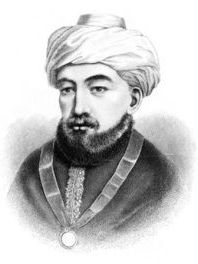
Image: Blaisio Ugolino · Public domain · Wikimedia Commons
Photographs, historical portraits or later depictions; not every person has an authentic portrait.
Maimonides
1138 – 1204
Jewish philosopher, legal scholar and physician from al-Andalus who spent most of his life in Egypt. He wrote the Mishneh Torah, a systematic ordering of Jewish law, and the 'Guide for the Perplexed', in which he sought to reconcile Jewish teaching with Aristotelian philosophy. His thirteen principles of faith appear in many prayer books.
Key facts
- Born
- 1138 · Córdoba
- Died
- 12 December 1204 (20 Tevet 4965)
- Place of death
- Fustat (Old Cairo), Egypt
- Cause of death
- unknown
- Era
- Middle Ages
Background & early life
Maimonides was born in Córdoba in 1138 as Moses ben Maimon; some sources give 1135. His father Maimon was a judge in the Jewish community and had studied with Joseph ibn Migash, the head of the Talmudic academy of Lucena. In Hebrew he is also called Rambam after his initials, in Arabic Abu Imran Musa ibn Maimun. According to later biographers he learned the Bible and the Talmud from his father, and he also read the Arabic works on philosophy, astronomy and medicine that circulated in al-Andalus.
In 1148 the Almohads took Córdoba. They no longer tolerated openly Jewish or Christian communities in their territory, and the family moved about for years without a fixed home. Whether the family later outwardly converted to Islam in Fez is disputed: later Islamic writers claim so, but there is no evidence from the time. From those years comes a letter attributed to him, in which he told Jews who professed Islam under compulsion that they remained Jews, but also advised them to leave.
Core activities & thinking
After the crossing to Acre in 1165 Maimonides visited Jerusalem and Hebron, and the family then settled in Fustat by way of Alexandria. There he completed his commentary on the Mishnah, in which he explained each chapter for readers who did not fully master the Talmud. In the introduction to the tenth chapter of the tractate Sanhedrin he formulated his thirteen principles of faith. He then listed the 613 commandments of the Torah in his 'Book of Commandments'.
With the Mishneh Torah, according to his introduction, he wanted to order the law in such a way that a reader would need no other book besides the Torah. He wrote in clear Hebrew, arranged the material by subject and largely left out the discussions of the Talmud and the names of scholars. Precisely that drew criticism: Abraham ben David of Posquières in Provence wrote objections in the margin of many passages, partly because Maimonides did not name his sources. The work is also called 'Yad ha-Hazakah', the strong hand, because the letters of yad add up to fourteen, the same as the number of books.
He wrote the 'Guide for the Perplexed' in Arabic for his pupil Joseph ben Judah and for readers like him, who knew philosophy and were confused by the literal text of the Bible. He read statements about God's hand or throne as metaphor, and of God's essence one could, in his view, say only what it is not. As a physician he also wrote a series of medical works in Arabic, among them on asthma and on poisons, and a treatise on a healthy way of life for the Ayyubid prince al-Afdal.
Zeitgeist & culture
The world of Maimonides was that of the Arabic-speaking Mediterranean. Jews in al-Andalus, the Maghreb and Egypt wrote Arabic in Hebrew letters, and scholars of different religions read Aristotle in the interpretation of al-Farabi and Ibn Sina. Ibn Rushd, who also came from Córdoba and was twelve years older, worked in the same tradition, although it is not known that the two ever met. In a letter to his later translator Samuel ibn Tibbon, Maimonides recommended above all the works of al-Farabi.
In Egypt Saladin ended the Fatimid caliphate in 1171 and established the rule of the Ayyubids, which left the Jewish community its own jurisdiction. Fustat was a trading city with connections as far as India. A letter that David, the brother of Maimonides, wrote to him from Aidhab on the Red Sea before his last journey is preserved in the Cairo Genizah, the storeroom for discarded writings in a synagogue of Fustat. Besides the Rabbanites, Karaites lived there, who rejected the oral law of the rabbis.
Societal impact
Even in his lifetime Maimonides became an authoritative legal scholar for communities far beyond Egypt. Jews in Yemen were under pressure to convert, and a man who presented himself as the messiah unsettled them. When they asked for advice, Maimonides replied with the 'Epistle to Yemen', which called for steadfastness and warned against that man. He answered questions from Provence and elsewhere in hundreds of written rulings, and drafts in his own hand are preserved in the Cairo Genizah.
His work also provoked opposition. In Baghdad the head of the Talmudic academy, Samuel ben Ali, accused him of denying the bodily resurrection of the dead, and in 1191 Maimonides replied with a treatise on resurrection. The Mishneh Torah was soon read throughout the Jewish world, but also distrusted. Critics feared that a code without sources would displace the study of the Talmud, and that his philosophy would undermine faith in revelation.
Death & legacy
End of life
- Date
- 12 December 1204 (20 Tevet 4965)
- Place
- Fustat (Old Cairo), Egypt
- Cause of death
- unknown
- Manner of death: Unknown
Circumstances
In his last decades Maimonides was personal physician to al-Qadi al-Fadil, Saladin's secretary, and then to members of the Ayyubid dynasty, while also leading the Jewish community of Fustat. In a letter he described coming home exhausted from the palace to find his antechambers full of Jewish and non-Jewish patients. Some biographers believe this heavy workload undermined his health. He died in Fustat on 12 December 1204; no cause of death is recorded. His son Abraham succeeded him as court physician and as nagid, the head of Egyptian Jewry. Medieval sources, beginning with al-Qifti, state that he was buried by the Sea of Galilee, but there is no contemporary evidence that his body was moved from Egypt. His tomb in Tiberias bears the inscription 'From Moses to Moses there arose none like Moses'.
Ibn Tibbon, who lived in southern France, translated the 'Guide' into Hebrew in consultation with Maimonides, and through that translation the book was read in Europe. In the early 1230s the conflict over his philosophical works flared up in Provence and Spain, and in Montpellier copies were burned, according to most accounts after Jewish opponents had turned to the Christian authorities. Through a Latin translation Thomas Aquinas cited him as 'Rabbi Moyses'. Joseph Karo based his code 'Shulchan Aruch' of 1565 partly on the Mishneh Torah.
In 1670, in his 'Theological-Political Treatise', Baruch Spinoza attacked the way in which Maimonides brought the Bible into agreement with reason. Hospitals such as the Rambam hospital in Haifa bear his name. The 'Physician's Prayer' attributed to him appeared only at the end of the eighteenth century in Germany and is probably by the physician Marcus Herz. In the twentieth century Leo Strauss argued that Maimonides deliberately built contradictions into the 'Guide' in order to hide his real views, which other scholars dispute.
Key moments
- Lived with his family in Fez around 1160, where he studied and wrote; in 1165 the family sailed to Acre.
- Came to Egypt around 1166, where he settled in Fustat near Cairo, and in 1168 completed his commentary on the Mishnah, written in Judeo-Arabic.
- Became a physician after his brother David, who supported the family through trade, had drowned in the Indian Ocean at some point between about 1169 and 1177; he later served as a physician at the Ayyubid court.
- Completed the Mishneh Torah around 1180, fourteen books in Hebrew that set out the whole of Jewish law.
- Wrote the 'Guide for the Perplexed' around 1190 and died in Fustat on 12 December 1204; according to tradition he was buried in Tiberias.
Known travels & key locations
Recorded places in this person's life. Connecting lines are schematic, not exact travel routes.
Elsewhere on the site
Sources
- Wikipedia: Maimonides
- Encyclopaedia Britannica: Moses Maimonides
- Maimonides: The Life and World of One of Civilization's Greatest Minds (2008) · Joel L. Kraemer
- Moses Maimonides: The Man and His Works (2005) · Herbert A. Davidson