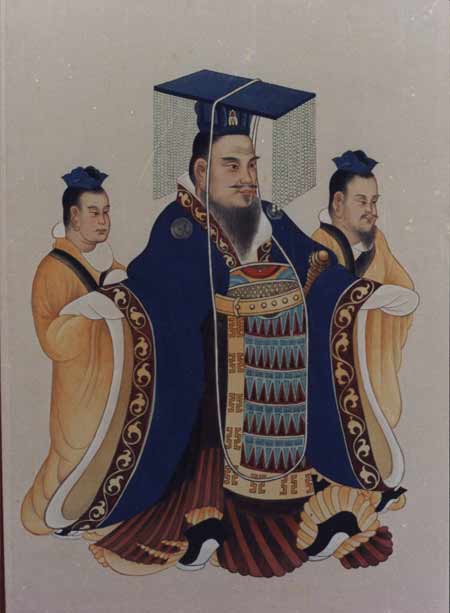
Image: Unknown author · Public domain · Wikimedia Commons
Photographs, historical portraits or later depictions; not every person has an authentic portrait.
Emperor Wu of Han
156 BCE – 87 BCE
Seventh emperor of the Han dynasty, who reigned for 54 years, from 141 to 87 BCE. He made Confucianism the state doctrine, centralised government, introduced state monopolies on salt and iron and expanded the empire into Korea, Vietnam and Central Asia. His envoy Zhang Qian established contacts that later developed into the Silk Road.
Key facts
- Born
- 156 BCE · Chang'an (Xi'an)
- Died
- 29 March 87 BCE
- Place of death
- Chang'an (near present-day Xi'an), China
- Cause of death
- illness
- Era
- Antiquity
Background & early life
Emperor Wu was born in 156 BCE as Liu Che, one of the younger sons of Emperor Jing. At first his chances of the throne were small, because Liu Rong, the emperor's eldest son, had been named crown prince. Court intrigue changed that: Liu Rong was deposed in 150 BCE, and a few months later Wang Zhi, the mother of Liu Che, was raised to empress. With that her son became the new heir to the throne.
An important ally was his aunt, Princess Guantao, whose daughter Chen Jiao married him. The well-known story in which the young prince promises to let her live in a golden house comes from a collection of tales written centuries later and is regarded as a legend. When Liu Che became emperor in 141 BCE at about fifteen years of age, his grandmother, Grand Empress Dowager Dou, had great influence at court. She adhered to the Daoist-tinged Huang-Lao thought and quickly reversed his first Confucian reforms.
Core activities & thinking
After the death of Grand Empress Dowager Dou in 135 BCE, Wu pressed on with the Confucian course. In 136 BCE he had already appointed scholars for the Five Classics, and from 134 BCE the commanderies had to recommend men who were regarded as filial and incorrupt. In those years the thinker Dong Zhongshu argued in memorials for Confucianism as the foundation of the state. In practice Wu also continued to use harsh laws and punishments, so that historians call his rule a mixture of Confucian language and Legalist methods.
Against the Xiongnu, Wu chose attack instead of the old policy of marriages and gifts. After the campaigns of Wei Qing and Huo Qubing he established commanderies such as Wuwei, Zhangye, Jiuquan and Dunhuang in the Hexi Corridor, where soldiers brought land under cultivation. In 109 BCE the kingdom of Dian in present-day Yunnan was subjugated. Between 104 and 101 BCE he twice sent General Li Guangli to Dayuan in the Ferghana Valley to obtain the coveted horses of that country.
The wars cost more than the treasury could raise. Around 119 BCE Wu therefore had state monopolies on salt and iron introduced, which were later extended under the official Sang Hongyang. In 118 BCE the wuzhu coin came into circulation, which remained China's standard coin for centuries. Merchants paid an extra tax on their property, and anyone who reported concealed wealth received part of it as a reward. In 104 BCE Wu had the Taichu calendar introduced, on which the historian Sima Qian, among others, worked.
Zeitgeist & culture
The Han dynasty had arisen in 202 BCE after the fall of the Qin. The first Han emperors had governed frugally according to the Huang-Lao ideal of little state intervention, so that according to Sima Qian, Wu inherited full granaries and treasuries. Within the empire there were still semi-independent kingdoms held by relatives of the emperor, seven of which had rebelled in 154 BCE. Wu weakened them further with an edict of 127 BCE that allowed kings to divide their land among younger sons as well, so that the kingdoms grew ever smaller.
On the northern frontier stood the confederation of the Xiongnu, mounted nomads under a chanyu, who in 200 BCE had surrounded the first Han emperor at Baideng. At court Wu also sought the advice of fangshi, magicians who promised immortality; Li Shaojun and Luan Da were among them, and Luan Da was executed after his deception. Sima Qian, who witnessed Wu's reign at close quarters, was castrated, according to his own letter to Ren An, after he had defended the defeated general Li Ling.
Societal impact
The expansion enlarged the empire to the north-west, the south and the north-east, but at a high price. To pay for the wars the state sold ranks and exemptions and levied new taxes, which hit merchants and farmers hard. For the peoples of Nanyue, Dian and Gojoseon a period of Chinese rule through commanderies began. In Korea the commandery of Lelang survived until 313 CE, long after the Western Han itself had fallen.
Within the government, power shifted. The recommendation system and the academy brought Confucian-trained men into office, while Wu weakened the chancellor by having policy made in a circle of personal advisers at court. The witchcraft trials of 91 BCE showed the other side of that personal power. According to the History of the Han, large numbers of people, among them high officials, were accused and executed, and Empress Wei Zifu, the mother of the crown prince, also lost her life in the affair.
Death & legacy
End of life
- Date
- 29 March 87 BCE
- Place
- Chang'an (near present-day Xi'an), China
- Cause of death
- illness
- Manner of death: Illness
Circumstances
After the revolt and death of Crown Prince Liu Ju in 91 BCE, Emperor Wu changed course: he had the instigators of the witch hunt at court punished, scaled back his wars and acknowledged mistakes in his policies in the so-called Luntai Edict. From 88 BCE he was seriously ill. Because he considered his older sons unsuitable, shortly before his death he named his youngest son, Liu Fuling, then still a child, as crown prince and appointed Huo Guang, Jin Midi and Shangguan Jie as regents. He had shortly before had the prince's mother, Lady Zhao, imprisoned; she died in captivity, according to some sources on his orders. Historians explain this by his fear that she would take over the government as empress dowager. Wu died on 29 March 87 BCE after a reign of 54 years and was buried in the Maoling mausoleum near Xi'an. Liu Fuling succeeded him as Emperor Zhao.
Six years after his death, in 81 BCE, the court had officials and Confucian scholars debate the monopolies on salt and iron. Huan Kuan worked that debate up into the book 'Discourses on Salt and Iron'; the monopolies largely remained in place. His posthumous name Wu, 'the martial', refers to his conquests. Wu also began the custom of giving periods within a reign a name of their own, a practice that later Chinese emperors continued.
The image of Wu is strongly shaped by Sima Qian, who wrote critically about his wars, his taxes and his quest for immortality, and by the later History of the Han by Ban Gu. Near his burial mound lies the tomb of Huo Qubing, with a stone statue of a horse trampling a Xiongnu warrior. In Chinese tradition he is often named together with Qin Shi Huangdi; Mao Zedong named both in his poem 'Snow' of 1936 as rulers with little literary talent. Historians still weigh whether his expansion made the empire stronger or exhausted it.
Key moments
- Sent Zhang Qian west in 139 or 138 BCE to seek an alliance against the Xiongnu; his journeys brought China into contact with Central Asia.
- Founded the Imperial Academy in 124 BCE, where future officials studied the Confucian classics.
- Had his generals Wei Qing and Huo Qubing push back the Xiongnu between 129 and 119 BCE, and annexed Nanyue (111 BCE) and Gojoseon in Korea (108 BCE).
- Performed the feng and shan sacrifices on Mount Tai in 110 BCE; in 91 BCE a witchcraft affair at court led to a revolt and the death of Crown Prince Liu Ju.
Known travels & key locations
Recorded places in this person's life. Connecting lines are schematic, not exact travel routes.
Elsewhere on the site
Sources
- Wikipedia: Emperor Wu of Han
- Encyclopaedia Britannica: Wudi
- The Cambridge History of China, Volume 1: The Ch'in and Han Empires (1986) · Denis Twitchett en Michael Loewe