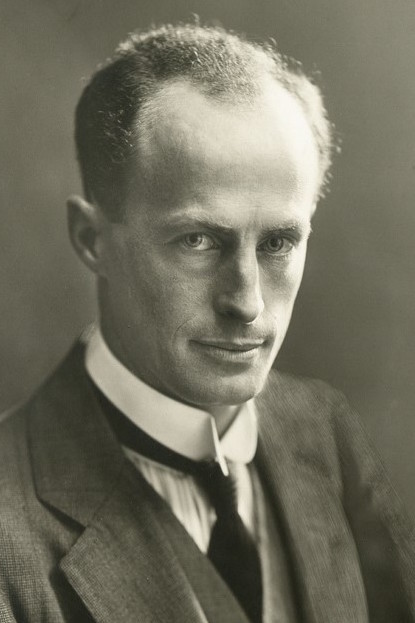
Image: Thompson, J. · Public domain · Wikimedia Commons
Photographs, historical portraits or later depictions; not every person has an authentic portrait.
Douglas Mawson
1882 – 1958
English-born Australian geologist and polar explorer. He took part in Ernest Shackleton's Nimrod Expedition (1907–1909) and led the Australasian Antarctic Expedition (1911–1914), which mapped large parts of the Antarctic coast; after his two companions had died, he covered the last part of the return journey alone. The BANZARE expedition he led (1929–1931) resulted in Australia's claim to a large part of Antarctica.
Key facts
- Born
- 1882 · Shipley
- Died
- 14 October 1958
- Place of death
- his home Jerbii in Brighton near Adelaide, South Australia
- Cause of death
- cerebral haemorrhage
- Era
- Modern era, Contemporary
Background & early life
Douglas Mawson was born on 5 May 1882 in Shipley, Yorkshire, the second son of Robert Ellis Mawson and Margaret Ann Moore. The family left for New South Wales in 1884 and settled at Rooty Hill near Sydney. In Sydney he attended the Fort Street Model School. At the university of that city he took a degree in mining engineering and metallurgy in 1902, and a science degree followed in 1905.
Two professors had a strong influence on his development: the geologist Edgeworth David and the chemist Archibald Liversidge. After his appointment at Adelaide, Mawson studied the rocks in the east of South Australia. Near Olary he was the first to describe the radioactive mineral davidite, which he named after David, and he gave the site the name Radium Hill. In 1909 he obtained the degree of Doctor of Science.
Core activities & thinking
Ernest Shackleton took Mawson on the Nimrod Expedition in 1907 as surveyor, cartographer and specialist in geomagnetism. From October 1908 Mawson, Edgeworth David and Alistair Mackay hauled their own sledges towards the South Magnetic Pole, a journey of months over sea ice, glaciers and the polar plateau. From their measurements they concluded that they had reached the area of the pole, after which they returned to the coast, where the Nimrod picked them up. In 1910 Mawson declined an invitation to go with Robert Falcon Scott and began to prepare an enterprise of his own.
The Australasian Antarctic Expedition was above all a scientific one. Besides the main base at Cape Denison there was a second base on the Shackleton Ice Shelf under Frank Wild, and on Macquarie Island a station that relayed radio messages between Antarctica and Australia. The ship Aurora was commanded by John King Davis. At Cape Denison katabatic winds from the ice plateau sometimes blew far above hurricane force. From the base, sledging parties set out along the coast and inland to map, to measure the weather and geomagnetism and to collect rocks.
The sledging journey to the east, which Mawson began on 10 November 1912 with Belgrave Ninnis and Xavier Mertz, ended in disaster. With Ninnis the sledge carrying most of the food and the tent also disappeared, after which the other two had to live on their dogs. Mawson wrote 'The Home of the Blizzard' (1915) about the expedition. From May 1916 he worked in Britain as a scientist for the Ministry of Munitions. During the BANZARE expedition of 1929–1931 he mapped another part of the coast in the Discovery and had British sovereignty proclaimed at several places.
Zeitgeist & culture
Mawson worked in the period now called the 'heroic age' of Antarctic exploration, when Scott, Shackleton and Amundsen strove for the South Pole. His expedition set out in the same season in which Amundsen and Scott reached the pole, but Mawson chose a coast that was still almost unknown and a programme of geology, biology, meteorology and geomagnetism. The Commonwealth of Australia had existed only since 1901, and the expedition was paid for by governments, societies and private donors. With the new wireless telegraphy the expedition kept in contact with Australia.
Between the world wars Antarctica became an area of territorial claims, partly because of whaling. Britain had established the Falkland Islands Dependencies in 1908 and in 1923 had given New Zealand the administration of the Ross Dependency, and France claimed Adélie Land in 1924. Norwegian expeditions, financed by the whaling shipowner Lars Christensen, were active in the same years in the waters south of the Indian Ocean. BANZARE served in part to secure the British and Australian claims to that part of the continent.
Societal impact
The scientific results of the expedition of 1911–1914 appeared in a long series of reports, the last of which came out only decades later. As professor at Adelaide Mawson trained students in geology and studied the ancient rocks of the Flinders Ranges. There he described deposits of a Precambrian ice age that extend over about 1,500 kilometres. His book and his lectures made the Antarctic coast south of Australia known to a wide public.
On the basis of BANZARE Australia passed an act in 1933 that took over the administration of a large part of Antarctica from Britain. Mawson continued to argue for a lasting Australian presence on the continent. After the Second World War the Australian National Antarctic Research Expeditions began, and in 1954 Australia opened a permanent station that was given his name, on a coast that BANZARE had mapped. The expedition had named that area after the Melbourne manufacturer Macpherson Robertson, who had helped to pay for it.
Death & legacy
End of life
- Date
- 14 October 1958
- Place
- his home Jerbii in Brighton near Adelaide, South Australia
- Cause of death
- cerebral haemorrhage
- Manner of death: Illness
Circumstances
Mawson retired from the University of Adelaide in 1952 but remained active, among other things as honorary curator of minerals at the South Australian Museum. In March 1958 he visited the Soviet Antarctic ship Kooperatsiya and spent several hours talking with the Soviet scientific leader Alexey Tryoshnikov. On 14 October 1958 he died of a cerebral haemorrhage at his home Jerbii in Brighton, a seaside suburb of Adelaide, where he had lived with his wife Paquita since 1920. He was 76. On 17 October he was given a state funeral at St Jude's Church in Brighton, in whose churchyard he was also buried. In 2008 a granite boulder from Arkaroola was placed on the grave of Douglas and Paquita Mawson as a memorial.
Mawson's Antarctic diaries were published in 1988 by Fred and Eleanor Jacka. The huts at Cape Denison are maintained by the Mawson's Huts Foundation. The death of Mertz is still a matter of debate. In 1969 the doctors John Cleland and Ronald Southcott proposed poisoning by vitamin A from dog liver, while others also give a large role to cold, exhaustion and malnutrition.
His name is borne by Mawson Peak, the highest summit of Heard Island, and by a medal that the Australian Academy of Science awards for research in the earth sciences. From 1984 to 1996 his portrait appeared on the Australian 100-dollar note. Besides the survival journey of 1912–1913, historians emphasise the scientific yield of his expeditions and his role in the Australian claim to Antarctica. In Adelaide the suburb of Mawson Lakes recalls him.
Key moments
- During the Nimrod Expedition he was in March 1908 among the first group to reach the summit of the volcano Mount Erebus, and on 16 January 1909, with Edgeworth David and Alistair Mackay, reached the then location of the South Magnetic Pole.
- Left Hobart in December 1911 as leader of the Australasian Antarctic Expedition and in January 1912 set up the main base at Cape Denison on Commonwealth Bay.
- On a sledging journey to the east lost his companion Belgrave Ninnis in a crevasse in December 1912 and Xavier Mertz in January 1913, probably from vitamin A poisoning from dog liver; Mawson covered the last 160 kilometres alone.
- Reached the base shortly after the expedition ship Aurora had left and therefore wintered a second year with six others, until December 1913; he was knighted in 1914.
- Was professor of geology and mineralogy at Adelaide from 1921 to 1952 and in 1929–1931 led the British Australian and New Zealand Antarctic Research Expedition (BANZARE) in the ship Discovery.
Known travels & key locations
Recorded places in this person's life. Connecting lines are schematic, not exact travel routes.
Sources
- Wikipedia: Douglas Mawson
- Australian Dictionary of Biography: Mawson, Sir Douglas (1882–1958)
- Encyclopaedia Britannica: Douglas Mawson
- Mawson: A Life (1999) · Philip Ayres