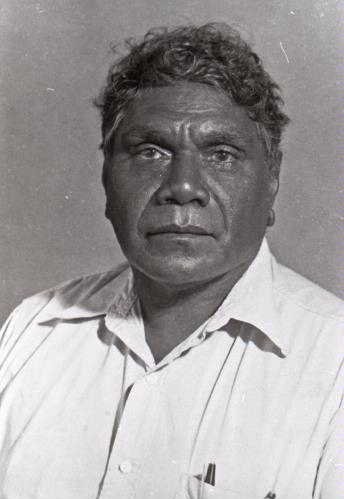
Image: Unknown author. · Public domain · Wikimedia Commons
Photographs, historical portraits or later depictions; not every person has an authentic portrait.
Albert Namatjira
1902 – 1959
Arrernte artist from Central Australia, known for his watercolours of the landscapes around the MacDonnell Ranges. He was one of the first Aboriginal artists to reach a large audience among non-Indigenous Australians.
In 1957 he was exempted from the guardianship rules that applied to most Aboriginal people in the Northern Territory; his conviction a year later drew criticism of that policy in Australia and abroad.
Key facts
- Born
- 1902 · Hermannsburg (Ntaria)
- Died
- 8 August 1959
- Place of death
- Alice Springs Hospital, Northern Territory, Australia
- Cause of death
- hypertensive heart failure, complicated by pneumonia
- Era
- Modern era, Contemporary
Background & early life
Albert Namatjira was born on 28 July 1902 at Hermannsburg, a mission station that German Lutheran missionaries had founded in 1877 in the country of the Western Arrernte. He attended the mission school and was brought up in the Christian faith there. At the age of thirteen he returned to the country outside the mission for his initiation according to Arrernte tradition. There he came to know the stories and places that held meaning for his clan.
At about eighteen he left the mission and married Ilkalita, a Kukatja woman who was later given the baptismal name Rubina. With that marriage he went against the kinship rules of his own people, because she did not belong to the group from which those rules allowed him to choose a wife. The couple had five sons and three daughters. To support his family he worked in the following years as a cameleer, among other jobs, and he carved and painted objects of wood.
Core activities & thinking
In 1934 the painters Rex Battarbee and John Gardner exhibited their watercolours at the mission in Hermannsburg. Battarbee, who had taught Namatjira, included three of his works in an exhibition of the Royal South Australian Society of Arts in Adelaide in 1937. In the same year Friedrich Albrecht, the superintendent of Hermannsburg, took ten of his watercolours to a Lutheran conference. A year later his first exhibition of his own followed in Melbourne.
Namatjira painted above all the country of the Western Arrernte around Hermannsburg: the ranges of the MacDonnell Ranges, Mount Sonder, gorges such as Palm Valley and the white eucalypts that grow in dry riverbeds. He worked with the technique he had learned from Battarbee, with clear colours and a deep perspective on the mountains. In his lifetime he made, according to estimates, about two thousand paintings.
With his income Namatjira tried to acquire land for his family. An application for a grazing lease was rejected because the land was set aside for a ballot among returned servicemen. When he tried to buy land in Alice Springs for a house, he was cheated, and he refused a free plot in a reserve on the edge of the town that the minister Paul Hasluck offered him.
Zeitgeist & culture
The Northern Territory was governed by the federal government, and the Aboriginals Ordinance of 1918 made an official, the Chief Protector, the legal guardian of almost all Aboriginal people. Under the Welfare Ordinance of 1953 they were declared 'wards' of the state, for whom the government decided on matters including residence, work, marriage and alcohol. Aboriginal people received the vote in federal elections everywhere only in 1962. The exemption that Namatjira received in 1957 applied only to him and his wife.
The Lutheran mission at Hermannsburg opposed some Arrernte rituals, but missionaries such as Carl Strehlow also recorded the language and myths of the Arrernte. Federal policy in the 1950s, for which the minister Hasluck was responsible, aimed at assimilation: Aboriginal people were in time to live like other Australians. In those years the work of Aboriginal people was collected mainly by ethnographic museums. That an Arrernte painter exhibited and sold in art galleries in the big cities was therefore unusual.
Societal impact
Namatjira's success brought income to Hermannsburg, and relatives and other residents also began to paint watercolours in what is called the Hermannsburg School. In keeping with the obligations of Arrernte kinship, he shared his income with a large circle of relatives; his biographers speak of hundreds of people who relied on him. Those obligations clashed with the law. After 1957 he was allowed to buy alcohol himself, but his relatives were not allowed to possess it, and from that contradiction came the case for which he was convicted.
Namatjira became known throughout Australia in the 1940s and 1950s. In 1944 he was included in 'Who's Who in Australia', and in 1947 the documentary 'Namatjira the Painter' appeared. In 1955 he became an honorary member of the Royal Art Society of New South Wales, and in 1956 a portrait of him by William Dargie won the Archibald Prize, the first painting of an Aboriginal person to win that prize. Reproductions of his watercolours were sold as prints and calendars, so that his landscapes also found their way into the homes of people who had never been to Central Australia.
Death & legacy
End of life
- Date
- 8 August 1959
- Place
- Alice Springs Hospital, Northern Territory, Australia
- Cause of death
- hypertensive heart failure, complicated by pneumonia
- Manner of death: Illness
Circumstances
In 1958 Namatjira was convicted of leaving a bottle of rum where a clan relative who was subject to the guardianship rules for Aboriginal people could reach it. His six-month prison sentence was reduced on appeal to three months, and the High Court refused leave for a further appeal. After public protests, the Minister for Territories, Paul Hasluck, allowed him to serve the sentence from March to May 1959 as open detention at the Papunya settlement. He was released after about two months on medical and humanitarian grounds. His biographers describe him as despondent after this period. At Papunya he suffered a heart attack and was taken to Alice Springs Hospital, where he gave the painter Rex Battarbee three more landscapes. He died on 8 August 1959 of hypertensive heart failure, or, according to other sources, of heart disease complicated by pneumonia. He was buried with Lutheran rites in the Alice Springs cemetery.
After his death the copyright in his work came under the administration of the Public Trustee of the Northern Territory, which sold it in 1983 for 8,500 Australian dollars. In 2017 the copyright returned to the family after a donation by the businessman Dick Smith. From 2009 the Namatjira Project of the theatre company Big hART brought his life and the struggle over the copyright to the stage.
Soon after his death some critics dismissed his style as a product of assimilation into Western culture. That view has largely been abandoned: scholars now also read his landscapes as depictions of places with a meaning of their own in Arrernte tradition. In 1968 he was depicted on Australian postage stamps. Descendants paint at the Iltja Ntjarra art centre in Alice Springs, and his great-grandson Vincent Namatjira won the Archibald Prize in 2020.
Key moments
- Learned watercolour painting in 1936 from the painter Rex Battarbee, whom he accompanied as a guide on a painting trip through the MacDonnell Ranges.
- Held his first solo exhibition in Melbourne in 1938, where all the works were sold.
- Met Queen Elizabeth II in Canberra in 1954, a year after receiving the Coronation Medal.
- Was exempted with his wife Rubina from the guardianship rules for Aboriginal people in 1957, allowing him to vote, own land and buy alcohol; his relatives remained subject to those rules.
- Was convicted in 1958 of leaving a bottle of rum where a clan relative, the painter Henoch Raberaba, could get at it; after an appeal he served two months of the reduced sentence at the Papunya reserve in 1959, and he died in Alice Springs in August of that year.
Known travels & key locations
Recorded places in this person's life. Connecting lines are schematic, not exact travel routes.