Image: ChrisOsenbrück · Public domain · Wikimedia Commons
Lost cities & civilisations
Thonis-Heracleion: the port that sank into the sea
2000 · Abu Qir Bay near Alexandria (Egypt)
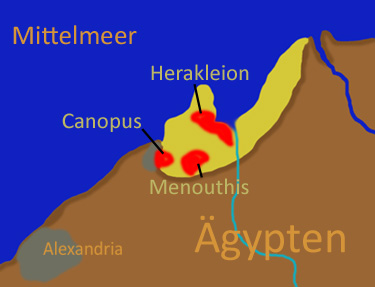
In 2000 the team of the French underwater archaeologist Franck Goddio found the remains of Thonis-Heracleion in Abu Qir Bay, some six kilometres off the coast. Before the founding of Alexandria in 331 BC this was Egypt's main port on the Mediterranean, where ships from the Greek world paid duty.
Earthquakes, a rising sea level and the sinking of the waterlogged clay soil made the city disappear gradually; its last parts went under water in the eighth century. The silt holds temples, colossal granite statues, dozens of shipwrecks and a stela that proved Thonis and Heracleion were one and the same city.
Key facts
- Date
- 2000
- Place
- Abu Qir Bay near Alexandria (Egypt)
- Country
- Egypt
- Category
- Lost cities & civilisations
- Significance
- Lesser-known
Background and run-up
Thonis-Heracleion lay at the Canopic mouth, the westernmost branch of the Nile Delta. Greek writers called the city Heracleion, after a temple of Heracles, while Egyptian texts used the name Thonis. According to Herodotus, Paris and Helen landed at the Canopic mouth after their flight from Sparta, after which servants of Paris took refuge in the temple of Heracles. In the middle of the city stood a large temple of Amun-Gereb.
Franck Goddio had founded the European Institute for Underwater Archaeology in 1987. In 1996 his team began to map the floor of Abu Qir Bay together with the Egyptian antiquities service. With sonar and magnetometers the researchers searched for remains beneath the silt.
Immediate consequences
The stela carried a decree of the pharaoh Nectanebo I from 380 BCE and has an almost identical counterpart found at Naukratis. The decree laid down that a tenth of the duties on imports from the Greek world went to the temple of the goddess Neith at Sais. Three granite statues of about five metres high, of a king, a queen and the Nile god Hapi, were raised from the water. Research on one of the wrecks, published in 2019, revealed a method of construction that matches the description Herodotus gave of the Egyptian cargo boat, the baris.
Legacy and remembrance
Finds from Thonis-Heracleion and nearby Canopus travelled in exhibitions to museums in Europe and the United States. The British Museum showed them in 2016 in the exhibition 'Sunken Cities'. The Oxford Centre for Maritime Archaeology publishes the results of the research in a series of monographs. According to Goddio only a small part of the city has been explored, and most of the remains still lie under water.
Timeline
380 BCE
Nectanebo I issues a decree on the duties on Greek imports for the temple of Neith.
331 BCE
Alexander the Great founds Alexandria, which gradually takes over the role of Thonis-Heracleion as a port.
1996
Franck Goddio's team begins to map the floor of Abu Qir Bay.
2000
Divers of the team find the remains of Thonis-Heracleion.
2016
The British Museum shows finds from the city in the exhibition 'Sunken Cities'.
On the map
Sources
- Wikipedia – Heracleion
- Sunken Cities: Egypt's Lost Worlds (2016) · Franck Goddio en Aurélia Masson-Berghoff