
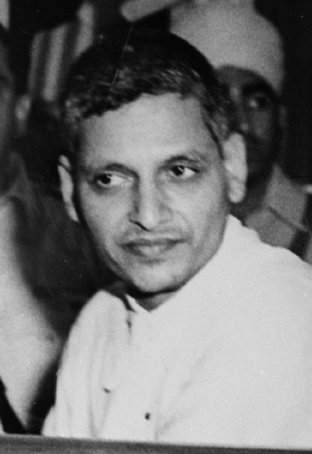
Image: Wilson Loo Kok Wee · CC BY-SA 2.0 · Wikimedia Commons
Politics & state formation
Assassination of Gandhi
30 January 1948 · Birla House, New Delhi
On 30 January 1948 Mohandas Gandhi, aged 78, was shot dead in the garden of Birla House in New Delhi as he walked to his evening prayer.
The assassin, Nathuram Godse, was a Hindu nationalist who accused Gandhi of favouring Muslims and Pakistan: shortly before, Gandhi had fasted to put an end to the violence between Hindus and Muslims after the partition of India. Prime Minister Nehru said on the radio that 'the light has gone out of our lives'. Godse was hanged in 1949.
Key facts
- Date
- 30 January 1948
- Place
- Birla House, New Delhi
- Country
- India
- Category
- Politics & state formation
- Significance
- Lesser-known
Background and run-up
At independence on 15 August 1947 British India was divided into India and Pakistan. In Punjab and Bengal millions of people fled, and historians estimate the number of deaths in the violence between Hindus, Sikhs and Muslims at several hundred thousand to two million. Gandhi tried to stop the violence with fasting and prayer, first in Calcutta and from September in Delhi. There he stayed at Birla House, the home of the Birla family of industrialists. His last fast lasted from 13 to 18 January 1948.
During that fast the Indian government decided to pay Pakistan 550 million rupees after all, a part of the divided reserves that it had withheld because of the war in Kashmir. Godse later named this payment in court as one of his motives. He was the editor of a Marathi newspaper in Poona and formed a conspiracy with a few associates. On 20 January one of them, Madanlal Pahwa, set off an explosive at Birla House during the evening prayer. Pahwa was arrested, but the others escaped.
Immediate consequences
Godse was seized on the spot. On 31 January Gandhi's body was cremated by the Yamuna, at the place now called Raj Ghat, in the presence of a large crowd. On 4 February the government banned the Hindu nationalist organisation Rashtriya Swayamsevak Sangh, the RSS, and had thousands of its members arrested. A special court in the Red Fort in Delhi sentenced Godse and Narayan Apte to death on 10 February 1949 and most of the other accused to life imprisonment. Vinayak Damodar Savarkar, the ideologue of Hindutva and former president of the Hindu Mahasabha, was acquitted.
Legacy and remembrance
India commemorates the anniversary of Gandhi's death on 30 January as Martyrs' Day. The ban on the RSS was lifted in July 1949. Whether Godse was still a member of the RSS at the time of the assassination is disputed: the organisation states that he had left it earlier, while his brother Gopal Godse later said that he had never left. In the 1960s a commission under Judge Jivan Lal Kapur examined anew the foreknowledge of the authorities and the role of Savarkar.
Timeline
15 August 1947
India becomes independent, and British India is divided into India and Pakistan.
13 January 1948
Gandhi begins his last fast in Delhi against the violence between the communities.
20 January 1948
An explosive set off by Madanlal Pahwa goes off at Birla House during the evening prayer.
30 January 1948
Nathuram Godse shoots Gandhi dead in the garden of Birla House.
4 February 1948
The Indian government bans the Rashtriya Swayamsevak Sangh.
15 November 1949
Godse and Narayan Apte are hanged in Ambala jail.
On the map
People involved

Sources
- Wikipedia – Assassination of Mahatma Gandhi
- Gandhi: The Years That Changed the World, 1914–1948 (2018) · Ramachandra Guha