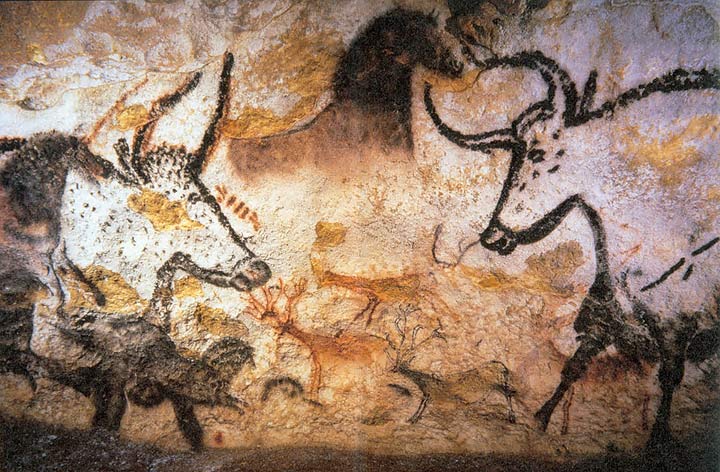
Aurochs, horses and deer. The photo dates from 2006, when the cave had been closed since 1963; it probably shows the Lascaux II replica.
Image: EU · Public domain · Wikimedia Commons
Lascaux cave paintings
Unknown artists (Magdalenian) · c. 17,000 years ago
On 12 September 1940 four young people, among them Marcel Ravidat, found the cave near Montignac. Its walls and vaults carry hundreds of painted animals and over a thousand engravings, mainly horses, deer, aurochs and bison. In the Hall of the Bulls the largest aurochs is over five metres long. In the Shaft a rare human figure appears beside a wounded bison.
Details
- Artist
- Unknown artists (Magdalenian)
- Date
- c. 17,000 years ago
- Movement
- Palaeolithic cave art
- Technique and materials
- Mineral pigments on limestone; also engravings
- Made in
- Montignac, Dordogne, France
- Current location
- In situ (closed); replica at Lascaux IV, MontignacStill in the place it was made for
Palaeolithic cave art
Movement · 40,000 BCE – 10,000 BCE · Europe · Franco-Cantabrian region (southern France and northern Spain)
Paintings, drawings and engravings on cave walls from the Upper Palaeolithic. The largest known concentration is in southern France and northern Spain; rock art of similar age has also been found in places such as Indonesia. The images mainly show large animals, along with hand stencils and abstract signs; human figures are rare. Their purpose is unknown: proposed explanations range from hunting rituals to shamanic practices.
Characteristics
- Pigments of ochre, manganese oxide and charcoal
- Animals as the main subject: horses, bison, aurochs, mammoths
- Use of the rock surface to suggest volume
- Hand stencils and geometric signs
Significance
After it opened in 1948, carbon dioxide, humidity and algae damaged the paintings; in 1963 the cave was closed. Replicas followed in 1983 (Lascaux II) and 2016 (Lascaux IV). The cave is a reference case in discussions on managing fragile heritage.
Made and kept
More from: Palaeolithic cave art
 HTO · Public domain · Replica of the panel of horses in the Anthropos Museum, Brno; the cave itself is closed. · Wikimedia CommonsIn December 1994 Jean-Marie Chauvet, Éliette Brunel and Christian Hillaire discovered this cave in the Ardèche. The walls show hundreds of animals, including horses, cave lions, mammoths and rhinoceroses. Predators, rarely shown in other caves, are numerous here. The makers sometimes scraped the wall clean first and used smudging to create shading. A rockfall sealed the entrance in prehistory, preserving traces of humans and cave bears.Palaeolithic cave artRock artHTO · Public domain · Replica of the panel of horses in the Anthropos Museum, Brno; the cave itself is closed. · Wikimedia Commons
Chauvet-Pont-d'Arc cave paintings
Unknown artists (Aurignacian) · c. 37,000–28,000 years agoIn situ (closed); replica at Grotte Chauvet 2, Vallon-Pont-d'Arc Museo de Altamira y D. Rodríguez · CC BY-SA 3.0 · Detail: one of the polychrome bison. · Wikimedia CommonsIn 1879 eight-year-old María Sanz de Sautuola noticed the paintings on the ceiling while her father was examining the cave floor. The ceiling shows, among other things, a group of bison in red and black; the makers used bulges in the rock to give the bodies volume. Uranium-thorium dating (2012) gave a red sign in the cave a minimum age of over 35,000 years.Palaeolithic cave artRock artMuseo de Altamira y D. Rodríguez · CC BY-SA 3.0 · Detail: one of the polychrome bison. · Wikimedia Commons
Polychrome ceiling of Altamira
Unknown artists (Magdalenian) · ceiling c. 16,500–14,000 years agoIn situ; replica at the Altamira Museum, Santillana del Mar